

-
 Phone:+86 189 2494 9366
-
 E-mail:info@zsshengshi.com
-
 No.5, north of the first road, Guyi Changweiyong manufacturingdistrict, Guzhen, Zhongshan, Guangdong, P.R.C
Project Procurement: Supplier Comparison Checklist Before RFQ

Project Procurement: Supplier Comparison Checklist Before RFQ
Key Takeaways: In project procurement, weak supplier comparison before RFQ usually leads to avoidable cost, lead time, and quality problems later. Buyers should compare not only price, but also process fit, finish control, engineering support, MOQ flexibility, and proof of production capability. A structured checklist before quotation helps procurement teams short-list factories that can actually deliver repeatable results.
In metal hardware and lighting accessories processing, the RFQ stage is often treated as the start of supplier evaluation. In practice, that is too late. By the time drawings, finish requirements, packaging details, and target pricing are sent out, many buyers have already included suppliers that are not a real fit for the job. That creates noisy quotations, misleading price comparisons, and wasted engineering time.
For project procurement, the better approach is to screen suppliers before RFQ based on capability evidence, communication quality, manufacturing fit, and commercial alignment. This matters especially when the parts involve mixed processes such as stamping, CNC machining, tube fabrication, welding, polishing, plating, powder coating, or assembly for lighting and hardware applications. A supplier may look competitive on unit price while still being weak on finish consistency, fixture control, or schedule reliability.
This checklist is designed for procurement teams, sourcing managers, engineers, and product managers who need a practical way to compare manufacturing partners before asking for quotations.
Why supplier comparison before RFQ matters
A poor supplier short-list affects more than purchasing efficiency. It can change the commercial outcome of the entire project. If a factory cannot control welding distortion, coating adhesion, dimensional tolerance, or assembly fit, the real cost appears later through rework, missed launch dates, incoming inspection failures, and customer complaints.
In hardware and lighting accessory projects, small process gaps often create large downstream risks. A supplier with limited polishing discipline may produce visible finish variation across batches. A factory that outsources plating without clear vendor control may struggle to match color tone. A shop that accepts low MOQs but has weak planning may repeatedly miss delivery windows. These are not minor operational issues; they directly affect margin, installation schedules, and buyer confidence.
Pre-RFQ comparison improves decision quality in four ways:
- It removes suppliers that are technically unsuitable before pricing distorts the decision.
- It reveals which factories understand the application and likely production risks.
- It helps procurement compare quotations on a like-for-like basis later.
- It reduces the chance of selecting a supplier that wins on price but fails in execution.
Common sourcing mistakes before quotation
Many supplier comparisons fail because buyers use incomplete or misleading signals. The issue is usually not lack of effort. It is using the wrong comparison logic too early in the process.
Common mistakes include:
- Comparing factories mainly by headline unit price instead of process fit.
- Sending RFQs to too many suppliers without screening manufacturing capability first.
- Assuming all metal suppliers can handle cosmetic-grade finishes for visible parts.
- Ignoring whether tooling, jigs, gauges, and inspection plans are managed in-house.
- Failing to confirm which processes are outsourced and how those vendors are controlled.
- Not checking whether the supplier has experience with similar assemblies, packaging, or compliance expectations.
- Accepting vague answers on lead time, MOQ, sample timing, or engineering change handling.
Another weak habit is comparing “capacity” only in terms of machine count. Machines matter, but production readiness depends just as much on fixture discipline, operator skill, quality checkpoints, finishing control, and communication speed. A smaller but well-managed factory can outperform a larger supplier that lacks process control.
What should buyers compare between suppliers before RFQ?
Before requesting prices, buyers should compare suppliers across technical, operational, and commercial criteria. The goal is not to choose the final supplier at this stage. The goal is to build a qualified RFQ list of factories that are likely to quote accurately and execute reliably.
| Comparison Area | What to Check | Strong Supplier Signal | Risk Signal |
|---|---|---|---|
| Process fit | Relevant stamping, machining, welding, finishing, assembly capability | Similar parts already in production | General capability claims only |
| Finish control | Surface prep, color consistency, adhesion, cosmetic inspection | Documented finish standards and samples | No measurable finish criteria |
| Engineering support | DFM feedback, tolerance review, assembly advice | Early risk comments on drawings | Quotes without technical questions |
| Quality system | Incoming, in-process, final inspection and traceability | Clear checkpoints and records | Inspection described vaguely |
| Lead time reliability | Planning method, bottlenecks, subcontract control | Realistic timeline with constraints stated | Over-promised standard lead times |
| MOQ flexibility | Prototype, pilot, and production batch options | MOQ tied to process economics | MOQ answer changes frequently |
| Communication | Response speed, clarity, issue escalation | Specific and consistent replies | Slow or incomplete responses |
| Commercial transparency | Tooling, finish, packaging, and logistics assumptions | Quoted scope clearly defined | Hidden assumptions in scope |
This comparison should be done before the RFQ package is finalized. If two suppliers have very different process routes or quality controls, their prices will not be directly comparable anyway.
What factory capability evidence should buyers request?
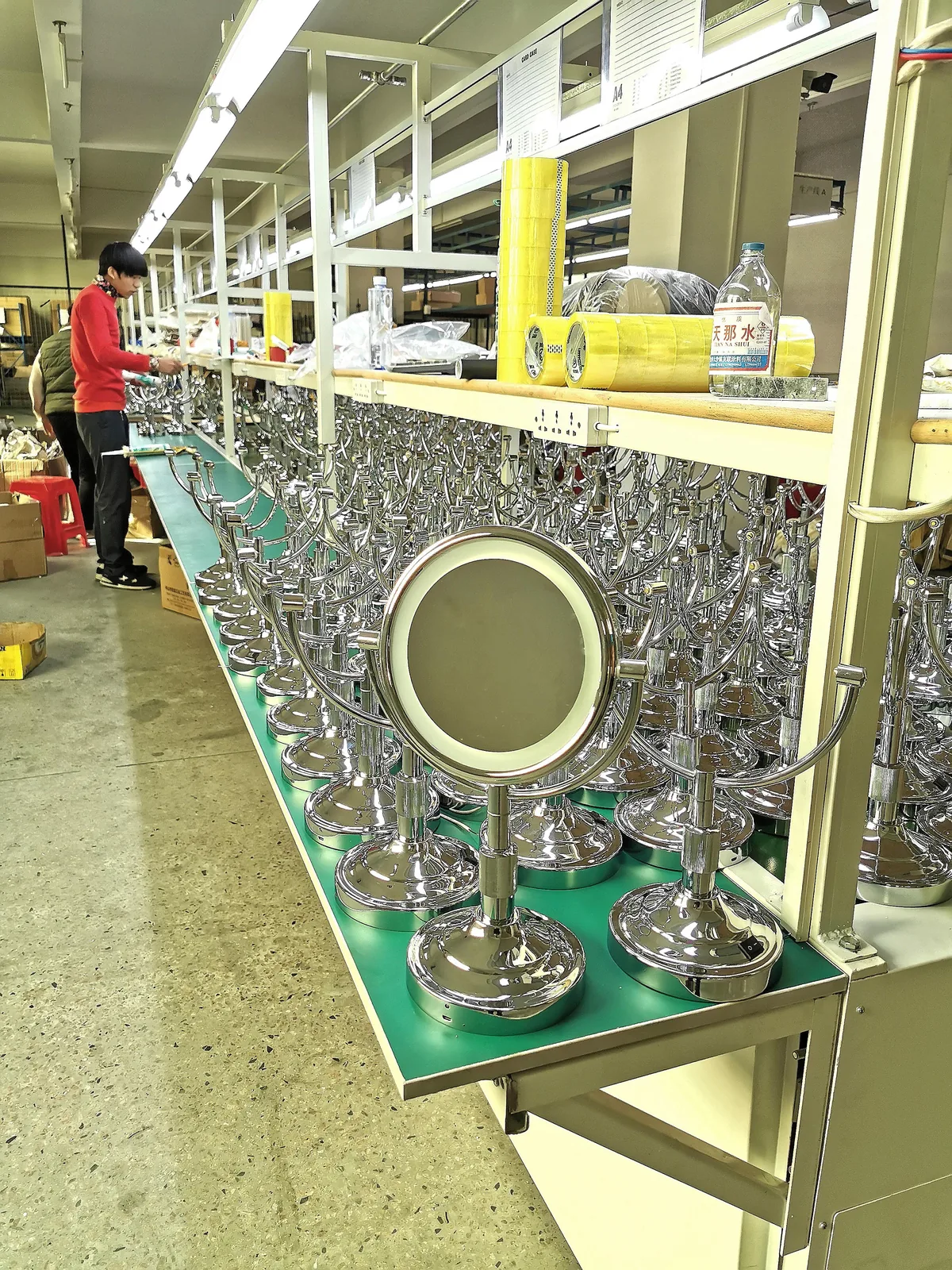
Reliable suppliers should be able to prove capability, not just describe it. In metal hardware and lighting accessories processing, buyers should ask for evidence tied to the actual manufacturing route of the part. This is especially important for visible components, custom assemblies, and projects with finish or fit-critical requirements.
Useful capability evidence includes:
- Photos or videos of relevant production equipment and process flow.
- Examples of similar parts, especially with comparable material, geometry, and finish.
- Inspection reports, dimensional records, or sample quality documents.
- Finish sample boards or previous production references for plating, powder coating, anodizing, or polishing.
- Tooling and fixture examples showing how repeatability is controlled.
- Packaging examples for export, retail, or assembly-line delivery requirements.
- Organization chart or contact structure for engineering, production, and quality support.
If a supplier relies on subcontractors for special finishing, laser cutting, die casting, or other steps, ask how those vendors are qualified and monitored. Outsourcing is not automatically a problem. The risk comes when the factory cannot explain ownership of quality, lead time, and corrective action across the outsourced steps.
| Evidence Type | Why It Matters | Acceptable | Better Evidence |
|---|---|---|---|
| Machine list | Shows baseline process range | Equipment summary | Machine list plus part examples |
| Sample photos | Confirms product similarity | Generic product photos | Dated samples with process notes |
| Inspection records | Shows control discipline | Final check report | In-process and final records |
| Finish samples | Reduces cosmetic risk | Color reference only | Approved panel with spec limits |
| Process flow | Reveals handoff and bottleneck risk | Verbal explanation | Written flow with checkpoints |
A practical supplier comparison checklist for project teams
A simple weighted framework helps cross-functional teams align before RFQ. Procurement may focus on price and lead time, while engineering focuses on tolerances and manufacturability. A shared checklist keeps the decision balanced.
| Checklist Item | Weight | What to Confirm | Pass Standard |
|---|---|---|---|
| Relevant manufacturing experience | 20% | Similar materials, structures, finishes | Documented comparable jobs |
| Engineering response quality | 15% | DFM questions and risk awareness | Specific comments before quote |
| Quality control readiness | 20% | Checkpoints, gauges, records, traceability | Clear inspection method |
| Finish consistency capability | 15% | Color, gloss, texture, adhesion control | Approved samples available |
| Lead time credibility | 10% | Schedule realism and bottleneck explanation | Timeline supported by process plan |
| MOQ and scaling fit | 10% | Prototype to mass production path | MOQ fits launch demand |
| Commercial clarity | 10% | Tooling, packaging, finish, Incoterm assumptions | Scope stated without gaps |
For ordinary sourcing projects, this type of scorecard is enough to narrow the list to two or three suppliers worth quoting. If a supplier scores low on process fit or quality readiness, there is little value in inviting them to RFQ just to create pricing pressure.
How to reduce sourcing risk before order confirmation
Even after supplier comparison and RFQ, buyers should confirm a short list of execution details before placing the first order. This is where many projects slip from a good sourcing decision into a difficult launch.
Before order confirmation, make sure the supplier can clearly answer the following:
- Which drawing revision, BOM version, and finish standard will control production?
- Which dimensions and cosmetic zones are critical, and how will they be inspected?
- What is the approved sample or golden sample reference?
- Which processes are in-house, and which are subcontracted?
- What are the tooling lead times, sample lead times, and mass production lead times?
- What packaging method protects cosmetic surfaces and prevents transit damage?
- How will deviations, rework, and engineering changes be communicated?
- What lot traceability or shipment identification will be provided?
For custom metal hardware and lighting accessories, finish consistency deserves special attention. A quote may specify powder coating, plating, or brushed finish, but that alone does not define an acceptable result. Buyers should confirm measurable standards or approved reference samples. Without that, both sides may believe the requirement is clear while interpreting it differently.
Lead time should also be broken into stages rather than accepted as one total number. Tooling, pilot samples, finish approval, production, and shipment each carry separate risks. A supplier that explains these stages transparently is usually more dependable than one offering a short but unsupported promise.
Conclusion: stronger project procurement starts before the RFQ goes out
The main lesson in project procurement is simple: better RFQs start with better supplier screening. If buyers compare factories only by quoted price, they often miss the real execution risks around quality control, lead time discipline, communication, MOQ fit, and finish repeatability. A structured pre-RFQ comparison helps teams remove weak options early and focus on suppliers that can support the project commercially and operationally.
If you are preparing a new sourcing round for metal hardware or lighting accessory components, the next practical step is to review the required manufacturing processes and compare them against real factory capability. You can review relevant Services to confirm process coverage, or prepare an RFQ package for a more technical discussion around drawings, finish standards, MOQ, and production expectations.
If your project involves finish, tolerance, or custom production questions, the next useful step is to review lighting hardware sourcing support and rfq before finalizing drawings, samples, or mass-production requirements.
 Floor Lamp Sets
 Wall Lamp Sets
 Table Lamp Sets
 Custom Hotel Parts
 Custom Made Parts
 Panels
 Tubes
Tubes Universal joints
 Machined Parts