

-
 Phone:+86 189 2494 9366
-
 E-mail:info@zsshengshi.com
-
 No.5, north of the first road, Guyi Changweiyong manufacturingdistrict, Guzhen, Zhongshan, Guangdong, P.R.C
Lighting Project Sourcing: Supplier Comparison Checklist for Quality and Lead Time

Lighting Project Sourcing: Supplier Comparison Checklist for Quality and Lead Time
Key Takeaways: In lighting project sourcing, the lowest quoted price rarely reflects the true landed cost if finish variation, delayed tooling, weak communication, or unstable lead times create rework and schedule risk. Buyers should compare suppliers on process control, finish consistency, engineering response, MOQ flexibility, and proof of production capability before order confirmation.
For procurement teams handling metal hardware and lighting accessories, supplier comparison is rarely just a price exercise. A bracket, canopy, stamped plate, spun part, tube assembly, or decorative metal component may look straightforward on a drawing, but project outcomes often depend on how well the factory controls tolerances, surface finish, packaging, and delivery rhythm. In practical lighting project sourcing, the supplier that wins on quotation alone can easily become the supplier that creates the most internal follow-up work.
This is especially true when projects involve custom finishes, mixed processes, or coordinated delivery with electrical parts, glass, or final assembly schedules. Buyers need a disciplined way to compare factories, verify what each supplier can actually produce, and identify risks before they become line stoppages, installation delays, or customer complaints.
Why supplier selection matters beyond unit price
In lighting hardware procurement, quality and lead time performance affect more than incoming inspection. A poor sourcing decision can increase engineering revisions, extend approval cycles, force emergency air shipments, and create finish mismatches between batches. If a decorative black powder coat shifts in gloss level, or a plated brass finish varies from one lot to another, the problem is not cosmetic only. It can trigger customer rejection, assembly sorting, or field replacement costs.
Commercially, reliable suppliers help buyers stabilize total cost. They reduce hidden expenses such as repeated sample rounds, unclear tooling ownership, uncontrolled subcontracting, and packaging damage in transit. Operationally, they support schedule confidence by confirming realistic lead times, production capacity, and inspection standards up front.
For sourcing managers and product teams, the right comparison question is not “Who quoted cheapest?” but “Which supplier can deliver the required quality level, finish consistency, and delivery performance with the lowest execution risk?”
Common mistakes buyers make when comparing lighting suppliers
Many sourcing reviews fail because suppliers are compared on incomplete information. The quotation sheet may look organized, but the underlying capability fit remains unclear. In metal hardware and lighting accessories processing, several weak comparison habits appear repeatedly:
- Comparing piece price without separating tooling cost, finish cost, packaging cost, and secondary-process cost.
- Accepting a lead time promise without checking raw material availability, in-house capacity, or outside finishing dependency.
- Reviewing samples only for appearance, not for dimensional repeatability or assembly fit.
- Failing to define cosmetic acceptance criteria for visible parts.
- Assuming one approved sample guarantees stable mass production.
- Not confirming whether critical processes are in-house or subcontracted.
- Ignoring MOQ impact on color, plating bath setup, or packaging economics.
Another common mistake is treating all factories as interchangeable. A supplier strong in simple laser-cut brackets may not be the right partner for spun shades, deep-drawn parts, multi-step polishing, or appearance-critical plated accessories. Buyers should compare suppliers against the actual process mix required by the project, not just against general manufacturing claims.
What should buyers compare between lighting project suppliers?
A useful supplier comparison framework should cover commercial fit, technical fit, and execution fit. The table below shows what procurement teams should evaluate side by side when screening potential manufacturing partners.
| Criteria | What to Check | Strong Supplier Signal | Risk Signal |
|---|---|---|---|
| Process capability | Stamping, spinning, welding, polishing, plating, coating, assembly | Clear process map and equipment list | Vague answers on how parts are made |
| Finish consistency | Color, gloss, plating tone, surface defects | Master sample and defined acceptance standard | No finish control method |
| Lead time reliability | Tooling, sample, pilot, mass production timing | Milestone-based schedule with capacity confirmation | Short promise without production logic |
| Engineering support | DFM feedback, tolerance review, cost-down ideas | Specific drawing comments before order | Only quotes what was sent |
| Quality control | Incoming, in-process, final inspection records | Inspection plan with measurable checkpoints | Relies on final visual check only |
| MOQ flexibility | Pilot runs, mixed models, finish setup constraints | Explains MOQ by process economics | Flat MOQ with no explanation |
| Communication | Response speed, issue ownership, documentation quality | Clear action list and revision tracking | Slow or inconsistent follow-up |
| Packaging control | Protection for coated or plated parts | Pack-out method tested for transit | Packaging decided after production |
This comparison becomes more useful when buyers score each supplier against the same drawing package, finish requirement, annual volume estimate, and delivery plan. If inputs differ, quotations and lead times are not truly comparable.
What factory capability evidence should buyers request?

Reliable suppliers should be able to prove capability, not just describe it. For lighting accessories and metal hardware, buyers should request evidence tied to the exact process risks in the project. If the part is appearance-critical, ask for finish-control evidence. If the part is assembly-critical, ask for dimensional control evidence. If timing is tight, ask for production-planning evidence.
Useful capability evidence includes:
- Similar part case examples by material, size, and finish type.
- Process flow chart showing which steps are in-house and which are outsourced.
- Equipment list relevant to the part family, such as stamping presses, spinning lathes, welding fixtures, polishing lines, or coating lines.
- Inspection records, first article reports, or control sheets for key dimensions.
- Finish samples under agreed lighting conditions, ideally with a retained master sample.
- Packaging photos or transit test approach for scratch-sensitive parts.
- Production schedule logic for tooling, sample approval, and batch release.
Buyers should also ask one direct question: which processes determine the actual lead time? The answer reveals whether the supplier understands bottlenecks. In many lighting projects, the true schedule constraint is not stamping or fabrication, but polishing queue, plating bath scheduling, powder coat color changeover, or outsourced finishing capacity.
Supplier comparison checklist for quality and lead time
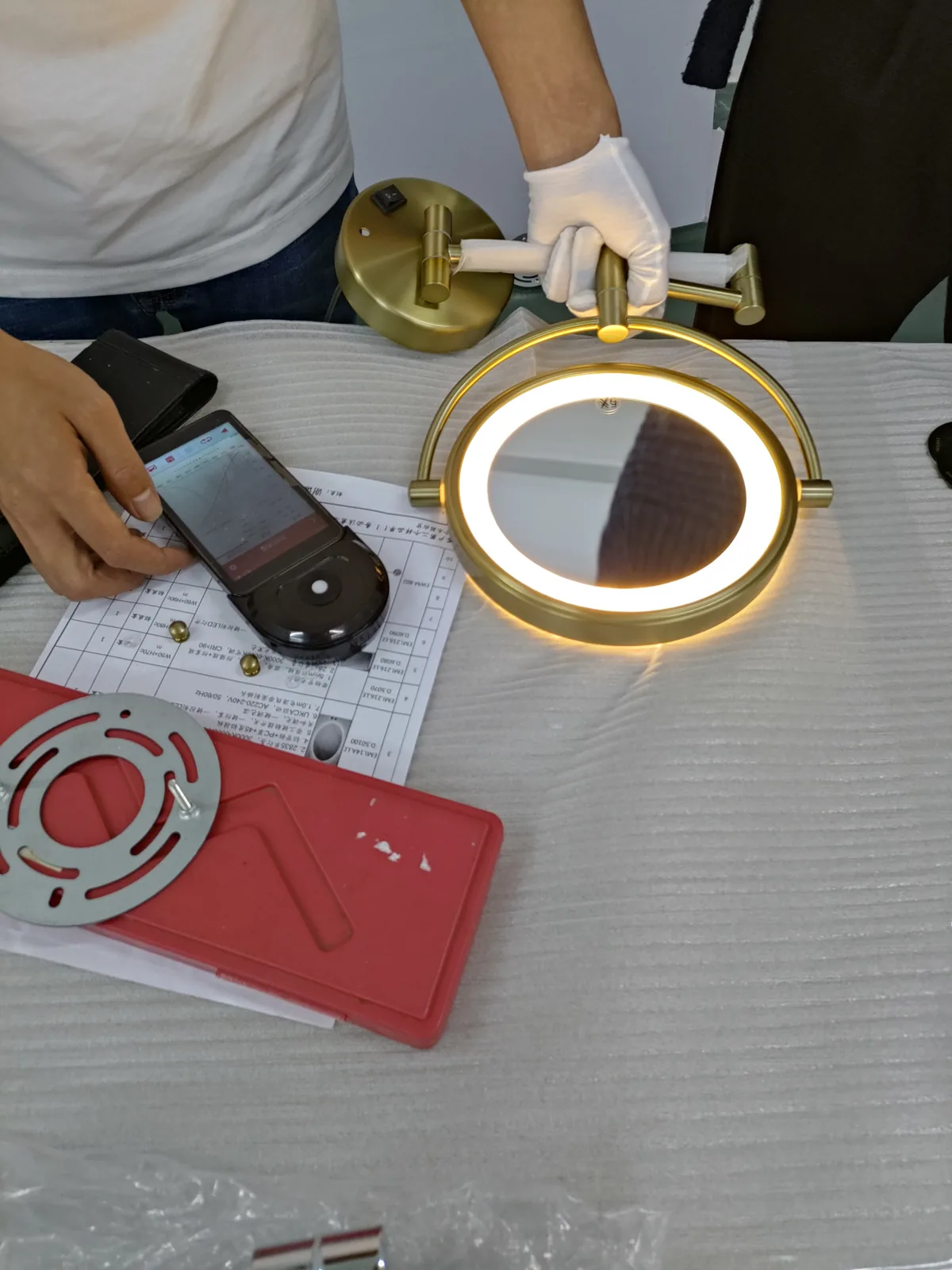
The checklist below can be used during RFQ review, supplier meetings, or sample approval discussions. It keeps the comparison focused on execution readiness instead of presentation quality.
| Checklist Item | Confirm? | Why It Matters |
|---|---|---|
| Quotation separates material, process, finish, tooling, packaging | Yes/No | Prevents hidden cost shifts later |
| Supplier reviewed drawings for manufacturability | Yes/No | Reduces revision and tooling risk |
| Critical dimensions and cosmetic zones are defined | Yes/No | Aligns inspection and acceptance criteria |
| Finish standard is approved by sample or reference | Yes/No | Controls batch-to-batch appearance variation |
| Lead time includes tooling, sample approval, production, finishing | Yes/No | Avoids unrealistic schedule commitments |
| MOQ and batch size are explained by process constraints | Yes/No | Improves planning for pilot and repeat orders |
| Inspection plan exists for incoming, in-process, final checks | Yes/No | Supports stable production quality |
| Packaging protects visible surfaces during shipment | Yes/No | Reduces transit damage and rework |
How to reduce sourcing risk before order confirmation
Before issuing a purchase order, buyers should convert assumptions into documented controls. This is where many avoidable problems can still be prevented. A few practical actions make a significant difference:
- Freeze the latest drawing revision and make sure quotation, sample, and order all reference the same version.
- Approve a golden sample for both dimensions and finish, especially for visible decorative parts.
- Confirm whether any process is subcontracted and who remains responsible for quality and schedule.
- Agree on defect criteria for cosmetic surfaces, weld marks, burrs, and color variation.
- Request a realistic production timeline with milestones instead of one final shipment date.
- Clarify tooling ownership, maintenance responsibility, and storage conditions.
- Verify packaging method before mass production, not after the first shipment complaint.
For new suppliers, a pilot order or pre-production batch is often worth the time. It gives buyers a chance to test communication speed, document control, finish stability, and packaging execution under real production conditions. In many cases, a supplier can make a good sample manually but struggle to hold the same standard across a full batch. That gap is exactly what the pilot run is meant to expose.
It is also good practice to align on response rules if a problem appears. Buyers should know who approves deviations, how nonconformance is reported, and how replacement or rework timing will be handled. Strong suppliers usually have a clear escalation path and do not hide behind vague statements when issues arise.
Choosing the right supplier profile for your project
Not every project needs the same supplier profile. A high-mix decorative program with multiple finishes may benefit from a factory with stronger engineering coordination and finish management, even if the unit price is slightly higher. A stable repeat-order bracket program may favor a highly efficient volume producer with tighter cost control. The key is matching supplier strengths to project priorities.
| Project Type | Best Supplier Strength | Main Buyer Focus | Main Risk |
|---|---|---|---|
| Custom decorative lighting | Finish control and sample management | Appearance consistency | Batch finish variation |
| OEM hardware parts | Dimensional repeatability | Assembly fit | Tolerance drift |
| Fast-launch new model | Engineering response speed | Sample and tooling timing | Revision delays |
| Repeat volume program | Capacity and cost stability | Delivery rhythm | Capacity squeeze |
This is why supplier selection should start from project requirements, not from a generic approved-vendor list. When the comparison criteria match the real production demands, procurement decisions become easier to defend internally and more reliable in execution.
Conclusion: build a better lighting supplier shortlist with evidence
Good lighting project sourcing depends on disciplined comparison, not optimistic assumptions. Buyers should evaluate suppliers on process capability, finish consistency, engineering support, communication discipline, MOQ logic, and realistic lead time control. The strongest manufacturing partners are the ones that can prove how they will meet requirements, not just promise that they can.
If you are comparing suppliers for custom metal hardware or lighting accessories, the next practical step is to review the relevant Services capability, prepare a clear technical package, and submit an RFQ for side-by-side evaluation. If your project includes OEM or ODM requirements, a focused discussion with the team can help confirm process fit, quality controls, and production readiness before you place an order.
If your project involves finish, tolerance, or custom production questions, the next useful step is to review lighting hardware sourcing support and rfq before finalizing drawings, samples, or mass-production requirements.
 Floor Lamp Sets
 Wall Lamp Sets
 Table Lamp Sets
 Custom Hotel Parts
 Custom Made Parts
 Panels
 Tubes
Tubes Universal joints
 Machined Parts