

-
 Phone:+86 189 2494 9366
-
 E-mail:info@zsshengshi.com
-
 No.5, north of the first road, Guyi Changweiyong manufacturingdistrict, Guzhen, Zhongshan, Guangdong, P.R.C
How to Match Repair Parts to Project Use Cases and Fit Requirements

How to Match Repair Parts to Project Use Cases and Fit Requirements
Key Takeaways: Matching repair parts to the real project use case is not only a dimensional exercise; it also affects finish consistency, installation speed, service life, and reorder risk. Buyers should compare suppliers on drawing control, material and finish capability, tolerance management, and communication discipline before approving production. The best sourcing decisions come from confirming fit requirements early and requesting factory evidence, not from choosing the lowest quoted unit price alone.
For procurement teams and engineers sourcing repair parts in metal hardware and lighting accessory projects, the main challenge is rarely just finding a factory that can make a part. The harder task is matching each part to the actual field condition, assembly interface, finish expectation, and replacement scenario. A repair bracket, threaded insert, stamped plate, lamp holder accessory, mounting clip, or decorative metal fitting may look simple on a drawing, but small differences in tolerances, coating thickness, hole position, edge condition, or base material can create installation failures and expensive returns.
This is why project fit matters. Some buyers need drop-in replacements for maintenance contracts. Others need upgraded parts that improve durability in commercial lighting, furniture hardware, retail display systems, or building fixture assemblies. In both cases, the supplier comparison should center on use case suitability: where the part is used, how often it is handled, what it must connect to, and what level of cosmetic consistency the end customer expects.
Why this decision matters commercially and operationally
When repair parts are mismatched to the application, the commercial impact appears quickly. Installation teams lose time modifying holes or forcing fit. Product managers face complaints about color mismatch or visible defects. Procurement teams end up placing urgent repeat orders with air freight because the original batch cannot be used. In OEM and ODM programs, these issues also damage confidence in the factory’s process control.
For metal hardware and lighting accessories, fit is multi-layered:
- Mechanical fit: hole spacing, thread type, thickness, bend angle, mating dimensions
- Functional fit: load-bearing ability, heat resistance, corrosion resistance, vibration stability
- Visual fit: finish color, gloss level, texture, burr control, weld appearance
- Assembly fit: compatibility with existing tools, line speed, packaging method, labeling
- Supply fit: MOQ, replenishment flexibility, repeatability across batches
A part that is technically manufacturable but poorly matched to the project use case often becomes more expensive over the full life of the program than a slightly higher-priced part produced by a more capable supplier.
Common sourcing mistakes when buying repair parts
In supplier reviews, buyers often compare quotations faster than they compare fit assumptions. That is where avoidable risk enters the project. The most common weak comparison habits include:
- Using old drawings without confirming field revisions or current mating parts
- Approving based only on overall dimensions while ignoring tolerance stack-up
- Comparing finish names instead of actual coating systems and sample panels
- Assuming every factory can manage low-volume mixed-part repair orders efficiently
- Not clarifying whether the supplier can support aftermarket reorders after initial production
- Skipping first-article approval because the part looks simple
- Failing to confirm packaging protection for plated or painted surfaces
These mistakes are especially common in maintenance-driven orders where the buyer is under time pressure. However, urgency is exactly when disciplined confirmation matters most. A fast quote is useful only if the supplier understands the service environment and assembly requirement behind the part.
What should buyers compare between suppliers?
A practical supplier comparison should connect factory capability to the specific repair scenario. For example, a decorative lighting trim ring for hospitality use should not be evaluated the same way as a galvanized mounting bracket for outdoor service access. The table below shows what buyers should compare side by side.
| Comparison Area | What to Confirm | Warning Sign | Reliable Supplier Signal |
|---|---|---|---|
| Drawing control | Revision history and critical dimensions marked | Quotes from unclear files | Asks for latest revision and tolerance notes |
| Material selection | Grade, hardness, corrosion need | Material named too generally | Provides material cert option |
| Finish capability | Color match, thickness, adhesion | Only verbal finish promise | Sample panel or finish spec review |
| Tolerance control | Hole position, bend angle, thread fit | No mention of inspection method | Defines gauges and checkpoints |
| MOQ flexibility | Support for service parts volume | Rigid MOQ without explanation | Explains setup cost and batch options |
| Lead time reliability | Tooling, sampling, mass production timing | Unusually short promise | Timeline broken into stages |
| Communication quality | Technical clarification speed | Answers only with price | Raises fit and use questions early |
This type of comparison helps procurement and engineering teams avoid false equivalence. Two suppliers may quote the same part number, but one is pricing to a documented requirement while the other is pricing to assumptions.
Matching repair parts to real buyer scenarios
Different buyer scenarios require different sourcing logic. A maintenance buyer replacing failed mounting hardware in the field needs short replenishment cycles and consistent fit with legacy assemblies. A product manager updating a lighting accessory line may need a visually improved replacement part that still fits old housings. An engineer solving repeated breakage may prioritize stronger material or thicker plating over exact duplication.
In practice, buyers should classify repair parts into one of three sourcing paths:
| Use Case | Priority | Best Supplier Fit | Key Confirmation |
|---|---|---|---|
| Exact replacement | Dimension match and reorder consistency | Factory with strong drawing and QC discipline | First article versus original sample |
| Performance upgrade | Better durability without assembly change | Supplier with engineering feedback ability | Material and finish upgrade validation |
| Mixed service parts | Flexible MOQ and packaging control | Factory used to small-batch consolidated orders | Part labeling and batch separation |
This framework is useful because it moves the discussion from “Can you make it?” to “Are you the right manufacturing partner for this repair program?” That is a better commercial question.
What factory capability evidence should buyers request?
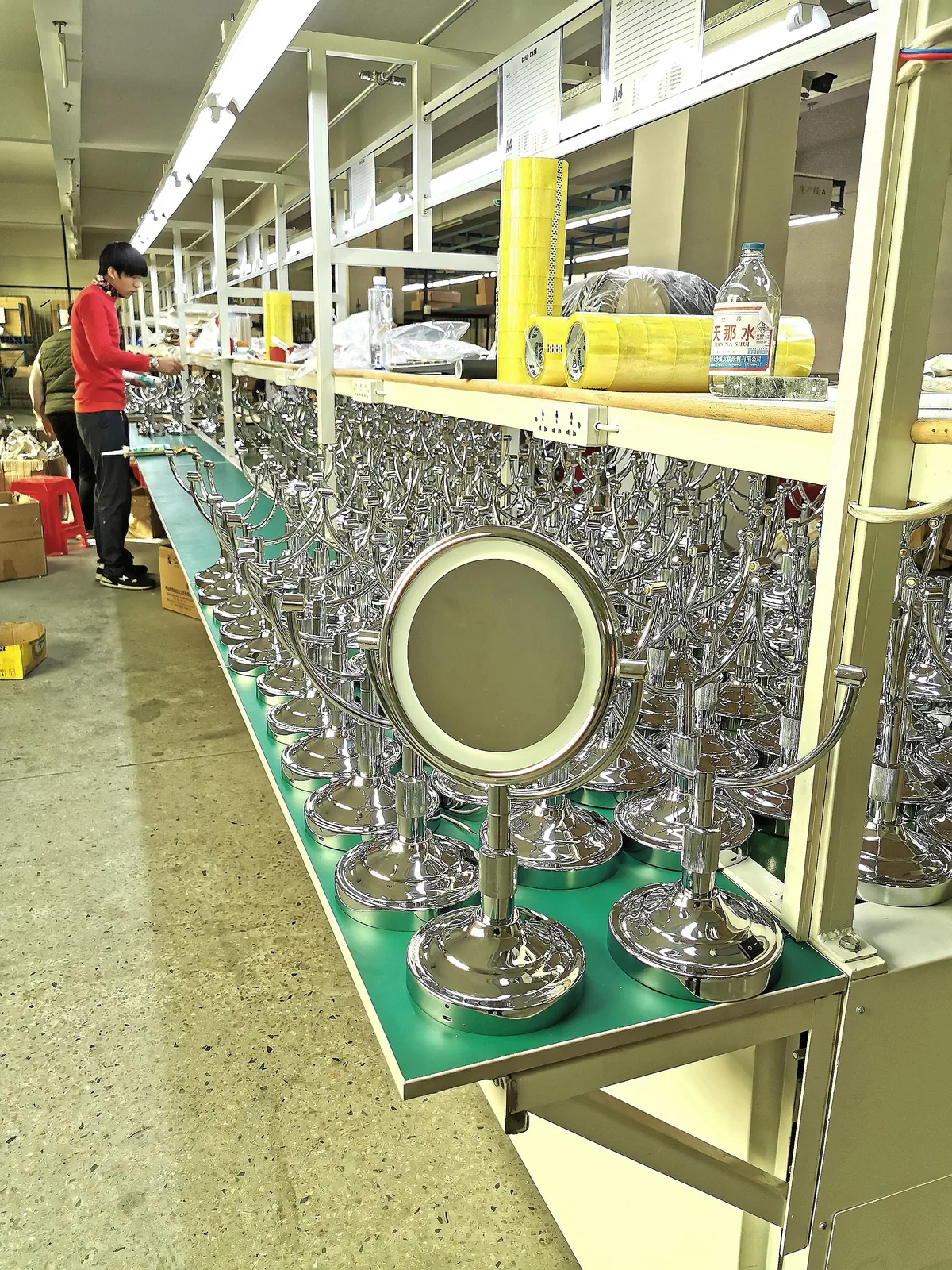
When a supplier claims capability, buyers should ask for evidence tied to the part type and process route. In metal hardware and lighting accessories processing, capability proof should be specific, recent, and relevant to the project. Generic brochures are not enough.
Useful factory evidence includes:
- Process flow for the part: stamping, CNC, bending, welding, polishing, plating, powder coating, assembly
- Inspection records for critical dimensions and thread checks
- Finish samples or photos under controlled lighting, ideally with reference codes
- Material certificates or traceability approach for production lots
- Tooling ownership and maintenance arrangement
- Packaging method for scratch-sensitive or plated components
- Examples of similar OEM or ODM projects with comparable complexity
- First-article procedure and approval workflow
If the project includes visible metal parts, ask how the supplier controls color and gloss variation between batches. If the part is functional and load-related, ask what inspection frequency is used for critical bends, threads, or weld points. If the order is low-volume aftermarket support, ask how they handle mixed SKUs without part confusion.
A reliable supplier should be able to explain not just what equipment they own, but how they use it to prevent the exact failure modes your project cannot accept.
Practical buyer checklist before placing an order
Before releasing a purchase order, use a short cross-functional checklist. This helps procurement, engineering, and product teams align on the same approval standard.
| Checkpoint | Owner | What Good Looks Like |
|---|---|---|
| Latest drawing and revision confirmed | Engineering | Controlled file issued to supplier |
| Use case and installation environment defined | Product team | Indoor, outdoor, decorative, structural clarified |
| Critical dimensions highlighted | Engineering | Inspection points agreed |
| Material and finish approved | Engineering/QA | Spec or sample signed off |
| MOQ and reorder plan understood | Procurement | Batch strategy fits service demand |
| Lead time by stage confirmed | Procurement | Sampling and mass production dates fixed |
| Packaging and labeling approved | Operations | No mix-up or finish damage risk |
How to reduce sourcing risk before order confirmation
Risk reduction does not require a complicated system. It requires a few disciplined steps before volume production starts. First, approve a first article or pilot batch against real mating parts, not only against the drawing. Second, lock the material and finish specification in writing, including any acceptable cosmetic range. Third, define which dimensions are critical to function and which are general reference dimensions.
Buyers should also confirm commercial details that often cause friction later:
- Whether tooling cost is included, separate, or amortized
- Whether MOQ applies per item, per finish, or per shipment
- Whether finish subcontracting adds lead time variability
- Whether replacement orders can be produced from the same tool and process route
- Whether the supplier will keep approved samples for future comparison
For projects with multiple repair SKUs, it is also wise to ask for a batch identification method. This improves traceability when one finish lot or one dimension issue needs review. Strong suppliers typically welcome this discussion because it helps prevent disputes later.
Conclusion: choose repair parts by project fit, not by part name alone
The right repair parts are the ones that fit the project technically, commercially, and operationally. Buyers should compare suppliers based on use case understanding, dimensional control, finish consistency, MOQ flexibility, and proof of process capability. That approach leads to better field performance and fewer reorder surprises.
If you are reviewing replacement hardware or lighting accessory requirements, the next practical step is to compare service capability against your actual part mix and application conditions. You can also review the available manufacturing services or start a sourcing discussion around OEM/ODM requirements, drawings, samples, and reorder expectations.
If your project involves finish, tolerance, or custom production questions, the next useful step is to review main company website and lighting hardware sourcing support before finalizing drawings, samples, or mass-production requirements.
 Floor Lamp Sets
 Wall Lamp Sets
 Table Lamp Sets
 Custom Hotel Parts
 Custom Made Parts
 Panels
 Tubes
Tubes Universal joints
 Machined Parts