

-
 Phone:+86 189 2494 9366
-
 E-mail:info@zsshengshi.com
-
 No.5, north of the first road, Guyi Changweiyong manufacturingdistrict, Guzhen, Zhongshan, Guangdong, P.R.C
Lighting Hardware Testing: QC Proof Points Buyers Should Request

Lighting Hardware Testing: QC Proof Points Buyers Should Request
Key Takeaways: Lighting hardware testing should not be treated as a generic QC promise. Buyers should ask for test methods, sample records, finish-performance evidence, and process-control proof that show a supplier can deliver repeatable quality at production scale. Strong suppliers do more than say parts are inspected—they show how defects are prevented, how specifications are verified, and how risks are controlled before shipment.
For procurement teams sourcing lamp bodies, brackets, canopies, mounting plates, threaded tubes, stamped parts, die-cast housings, and other metal lighting accessories, lighting hardware testing is one of the clearest ways to separate a capable factory from a trading-only offer or a workshop with inconsistent controls. The issue is not whether a supplier claims to do quality checks. Most do. The real question is whether that factory can prove the hardware will meet fit, finish, strength, and assembly requirements across multiple production lots.
This matters especially when the product includes plated, painted, brushed, powder-coated, or polished surfaces, where visual consistency and corrosion resistance directly affect customer acceptance. It also matters when hardware must mate with electrical components, glass, shades, fasteners, or wall/ceiling mounting systems. A low unit price loses value quickly if parts arrive with finish variation, poor thread accuracy, burrs, weak welds, or packaging damage that creates line stoppages or field complaints.
Why this decision matters commercially and operationally
Lighting hardware defects rarely stay isolated inside the metal part category. They usually spread cost into assembly, rework, freight, replacement, and customer service. A canopy with poor flatness may create installation issues. Inconsistent plating thickness may pass visual review at first but fail in humid environments. A bracket with hole-position deviation may force manual adjustment on the assembly line. These are sourcing problems, not just technical problems.
From a commercial standpoint, buyers should look at testing evidence as a predictor of total supply performance. Factories with stronger verification systems tend to communicate more clearly about tolerances, tooling risk, process changes, and finish limitations. Factories with weak testing discipline often quote aggressively but leave too much undefined until mass production, where corrections become expensive.
For product managers and engineers, the testing conversation also helps confirm whether a supplier understands the application. A factory that asks about indoor versus outdoor use, target finish life, torque requirements, mounting loads, or packaging drop risk is usually managing the product as a manufacturing project. A factory that only asks for drawings and quantity may still be useful, but buyers should request more proof before awarding volume.
Common mistakes buyers make when comparing suppliers
One common mistake is comparing quotes without comparing the testing scope behind them. Two suppliers may appear to offer the same part at similar specifications, but one may include incoming material checks, in-process dimensional control, adhesion testing, salt spray testing, and pre-shipment AQL inspection, while the other relies mainly on visual checks. The quoted part is the same on paper, but the risk profile is not.
Another weak comparison habit is accepting generic statements such as “100% inspection” or “strict QC” without asking what is actually measured, how often, by whom, and with what records. In metal hardware and lighting accessories, 100% inspection often means only basic visual sorting. It does not automatically cover thread gauge verification, coating thickness, weld integrity, dimensional capability, or packaging validation.
Buyers also underestimate finish consistency risk. Color, gloss, texture, and plating appearance can vary by lot, substrate condition, pretreatment quality, and subcontracted finishing control. If the supplier cannot provide clear finish standards, approved retain samples, and batch-to-batch comparison methods, repeat orders may drift even when the drawing stays unchanged.
A final mistake is waiting until PO placement to clarify acceptance criteria. Before ordering, buyers should confirm critical dimensions, cosmetic standards, test methods, defect classification, packaging requirements, and what happens if results fall outside agreed limits.
What should buyers compare between lighting hardware suppliers?
When evaluating suppliers, compare proof points rather than promises. The goal is to understand whether the factory can control both the part and the process. The table below shows practical comparison points that procurement and engineering teams can use during supplier review.
| Comparison Area | Weak Supplier Signal | Strong Supplier Signal | What Buyers Should Ask For |
|---|---|---|---|
| Dimensional control | Only final visual check | In-process checks with gauges and records | Inspection plan and sample reports |
| Finish performance | No clear standard by finish type | Adhesion, thickness, corrosion testing by spec | Test records and approved finish samples |
| Thread and fit | Checked only during assembly complaints | Go/no-go gauges and mating tests | Gauge list and assembly verification |
| Material traceability | Material source unclear | Batch traceability to incoming material | Material certs and lot tracking method |
| Packaging protection | Standard carton only | Part-specific anti-scratch packaging | Packaging spec and transit test evidence |
| Corrective action | Problem solved informally | Root-cause analysis with closure records | Recent CAPA example |
| Communication speed | Late or vague replies | Clear technical feedback before PO | Project contact process and escalation path |
This type of comparison helps buyers avoid choosing a supplier based only on quoted price or sample appearance. A polished first sample can be outsourced or hand-corrected. Production control is harder to fake.
What factory capability evidence should buyers request?
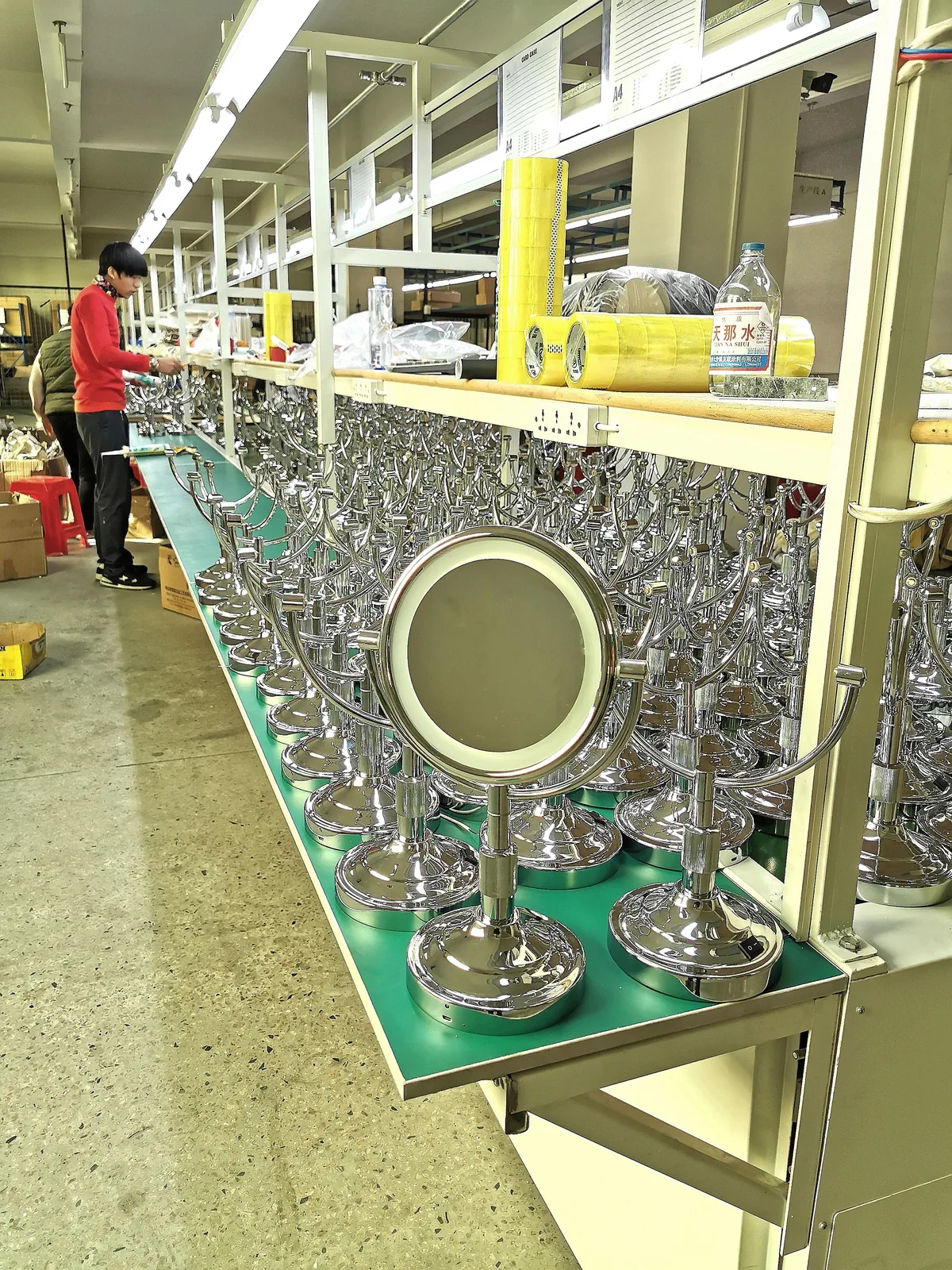
If your objective is sourcing confidence, ask for evidence tied to the actual hardware category and finish process you are buying. Generic certifications may be useful, but they do not replace product-specific proof.
For metal lighting hardware, reliable suppliers should be ready to provide:
- Dimensional inspection reports for critical features such as hole position, thread size, flatness, wall thickness, bend angle, and overall fit.
- Finish test records relevant to the product, such as coating thickness, cross-hatch adhesion, hardness, color comparison, gloss check, and salt spray performance where required.
- First article or pre-production approval records showing how the factory validates tooling output before volume production.
- Photos or video of key production and inspection steps, especially for stamping, welding, polishing, plating, powder coating, assembly, and packaging.
- Gauge and equipment lists showing the factory has the tools needed to verify the tolerances on your drawing.
- Examples of control plans, inspection standards, or defect criteria used for cosmetic and dimensional acceptance.
- Packaging validation evidence for scratch-sensitive, plated, or painted components.
Where a finish is subcontracted, buyers should also ask who controls that process, how finish lots are approved, and whether the hardware factory performs incoming finish verification before packing. Many quality problems in lighting accessories come from weak management of outside finishing partners rather than from the metal forming process itself.
| Evidence Type | Why It Matters | Minimum Buyer Expectation | Stronger Proof Point |
|---|---|---|---|
| First article report | Confirms tool output | Critical dimensions checked | Full report with photos and sign-off |
| Finish test data | Reduces appearance and corrosion risk | Basic adhesion and thickness checks | Lot-based records by finish code |
| Inspection plan | Shows control logic | Final inspection criteria | Incoming, in-process, and final checkpoints |
| Process capability proof | Supports repeatability | Stable sample output | Trend data across multiple lots |
| Corrective action record | Shows problem-solving discipline | Issue summary and response | Root cause, action, verification, closure |
A practical buyer checklist for lighting hardware testing

Before approving a supplier or releasing a production PO, use a simple checklist that procurement, engineering, and quality can review together. This helps prevent the common disconnect where technical assumptions stay with engineering while commercial risk stays with sourcing.
- Are critical dimensions identified and tied to a measurement method?
- Is the cosmetic standard defined with photos, retain samples, or defect limits?
- Is the required finish performance clearly stated by environment and use case?
- Has the supplier provided actual test records, not just a sample certificate template?
- Are thread, fit, and mating-part checks included in the validation plan?
- Is packaging designed for the actual finish sensitivity of the part?
- Is MOQ realistic for the process, finish, and tooling route?
- Has the supplier explained lead time by production step, including outsourced finishing if any?
- Is there a named technical contact who can answer deviation and change-control questions?
- Is the pre-shipment acceptance method agreed before order confirmation?
If several answers remain unclear, the buyer is not yet comparing suppliers on equal terms.
How to reduce sourcing risk before order confirmation
The safest time to control risk is before mass production begins. Once metal hardware enters plating, coating, assembly, and export packing, correction costs rise quickly. Buyers can reduce this risk by locking down the technical and commercial basics early.
First, align the drawing, finish code, and acceptance standard. If your team approves a sample, record why it was approved. Was it color, gloss, edge quality, thread engagement, or assembly fit? Without that record, repeat orders may drift because the supplier and buyer are each using different memories of the approved standard.
Second, request a pre-production review for any custom or OEM/ODM item. This should cover tooling readiness, process route, likely defect modes, subcontracted steps, and inspection points. For more complex programs, ask for a pilot run or limited first batch before full release.
Third, confirm the lead-time structure, not just the promised ship date. A supplier may quote a competitive timeline but still depend on overloaded polishing, plating, or powder-coating partners. If finish capacity is the bottleneck, the delivery risk remains even when metal fabrication is in-house.
Fourth, clarify MOQ and replenishment logic. Some suppliers quote low trial quantities but require higher MOQs once tooling, finish setup, or special packaging is involved. Buyers should confirm what changes between sample stage, pilot run, and repeat production.
Finally, define the response path if quality issues appear. Reliable suppliers should explain how nonconforming parts are isolated, how replacement or rework decisions are made, and how corrective actions are documented. This is an important trust signal because it shows how the factory behaves under pressure, not only when the order runs smoothly.
Conclusion: use lighting hardware testing as a sourcing proof tool
In practice, lighting hardware testing is not just a QC checkpoint. It is a sourcing proof tool that helps buyers judge whether a factory can deliver stable dimensions, consistent finishes, reliable assembly fit, and predictable communication through production. When suppliers provide real evidence—inspection plans, first article data, finish test records, packaging validation, and corrective action examples—buyers can compare capability with more confidence and less guesswork.
If you are reviewing manufacturing partners for metal lighting accessories, the next useful step is to compare service capability against your product’s actual testing needs, finish requirements, and OEM/ODM complexity. You can review our About Us and Services information to see how production, finishing, and quality control are managed, or discuss your part drawings and sourcing requirements with our team for a more practical evaluation.
If your project involves finish, tolerance, or custom production questions, the next useful step is to review factory capability overview and lighting hardware sourcing support before finalizing drawings, samples, or mass-production requirements.
 Floor Lamp Sets
 Wall Lamp Sets
 Table Lamp Sets
 Custom Hotel Parts
 Custom Made Parts
 Panels
 Tubes
Tubes Universal joints
 Machined Parts