

-
 Phone:+86 189 2494 9366
-
 E-mail:info@zsshengshi.com
-
 No.5, north of the first road, Guyi Changweiyong manufacturingdistrict, Guzhen, Zhongshan, Guangdong, P.R.C
Lighting Hardware Compliance Proof: Factory QC Checks Buyers Should Verify

Lighting Hardware Compliance Proof: Factory QC Checks Buyers Should Verify
Key Takeaways: Buyers should not treat lighting hardware compliance as a certificate-only issue. Reliable suppliers prove compliance through incoming material control, in-process inspection, finish validation, traceable records, and clear corrective action systems that protect quality, lead time, and commercial predictability.
For procurement teams sourcing lamp brackets, canopies, housings, stamped parts, threaded components, and plated or powder-coated accessories, the challenge is rarely just finding a factory that can make the part. The harder task is verifying whether that factory can consistently produce parts that meet drawing requirements, finish expectations, and customer market standards without creating hidden risk. That is where lighting hardware compliance becomes a practical sourcing issue, not just a paperwork exercise.
In metal hardware and lighting accessories processing, non-compliance often shows up in ordinary ways: coating thickness outside spec, burrs on stamped edges, inconsistent thread fit, poor salt spray performance, missing material traceability, or mixed packaging labels that confuse downstream assembly. These problems may not appear in a supplier quotation, but they directly affect incoming inspection results, assembly efficiency, warranty exposure, and delivery reliability.
Buyers comparing manufacturing partners should therefore ask a simple question: what can the factory prove, with records, samples, and process controls, before an order is released at scale?
Why this decision matters commercially and operationally
A lighting hardware supplier that cannot prove control over compliance-related quality creates cost in multiple departments at once. Procurement sees unstable pricing because rework and scrap are hidden in future quotes. Engineering loses time on repeated clarification and deviation approval. Quality teams face more incoming inspection failures. Production teams deal with line stoppages when dimensions, finishes, or fit-up vary from batch to batch.
For many buyers, the issue is not whether a supplier has ever passed an audit. The issue is whether the supplier can maintain process discipline across routine production, custom OEM/ODM changes, and finish variations. In lighting accessories, a small deviation in hole position, weld alignment, plating appearance, or thread quality can make an assembled product look cheap or fail functional checks.
That is why supplier selection should consider compliance proof as part of total sourcing performance. A lower unit price loses value quickly if the factory cannot hold tolerances, maintain finish consistency, or provide traceable inspection evidence when a claim occurs.
Common mistakes buyers make when comparing suppliers
Many sourcing teams compare suppliers on quotation speed, tooling cost, and sample appearance, but spend too little time verifying the control system behind the sample. This creates false confidence. A supplier may deliver an acceptable first sample while still lacking the process discipline required for repeat production.
- Accepting certificates without checking whether they relate to the actual process, product family, or subcontracted finish.
- Reviewing final inspection only, while ignoring incoming material checks and in-process control points.
- Comparing sample quality without comparing measurement methods, gauges, and acceptance criteria.
- Assuming outsourced plating or coating is controlled, even when the hardware factory has weak supplier management.
- Overlooking packaging and labeling controls that affect traceability and shipment accuracy.
- Placing trial orders before confirming how nonconforming material is segregated and corrected.
Another weak habit is treating all metal hardware factories as operationally similar. In practice, one supplier may have strong stamping capability but weak finish control. Another may manage welding well but lack dimensional discipline on secondary machining. Buyers need evidence by process, not broad claims.
What should buyers compare between lighting hardware factories?
When evaluating suppliers, compare the proof behind the quotation, not just the quotation itself. The table below shows the checkpoints that matter most when sourcing lighting hardware parts with compliance-sensitive requirements.
| Criteria | Weak Supplier Signal | Reliable Supplier Signal | Buyer Verification Method |
|---|---|---|---|
| Material control | No batch traceability | Heat or lot tracking recorded | Request incoming inspection records |
| Dimensional QC | Manual spot checks only | Control plan with gauge list | Review first article report |
| Finish consistency | Visual approval only | Thickness and adhesion checks | Ask for finish test reports |
| Subsupplier control | Outsourcing not disclosed | Approved vendor list managed | Confirm outsourced process map |
| Nonconformance handling | Rework handled informally | Segregation and CAPA records | Request sample NCR workflow |
| Packaging traceability | Generic carton labels | Lot-linked labels and counts | Check packing specification |
| Communication discipline | Answers are verbal only | Specs and deviations documented | Test response speed and clarity |
This kind of side-by-side comparison helps procurement teams avoid a common trap: giving too much weight to a polished sample presentation and too little weight to repeatability controls.
What factory capability evidence should buyers request?
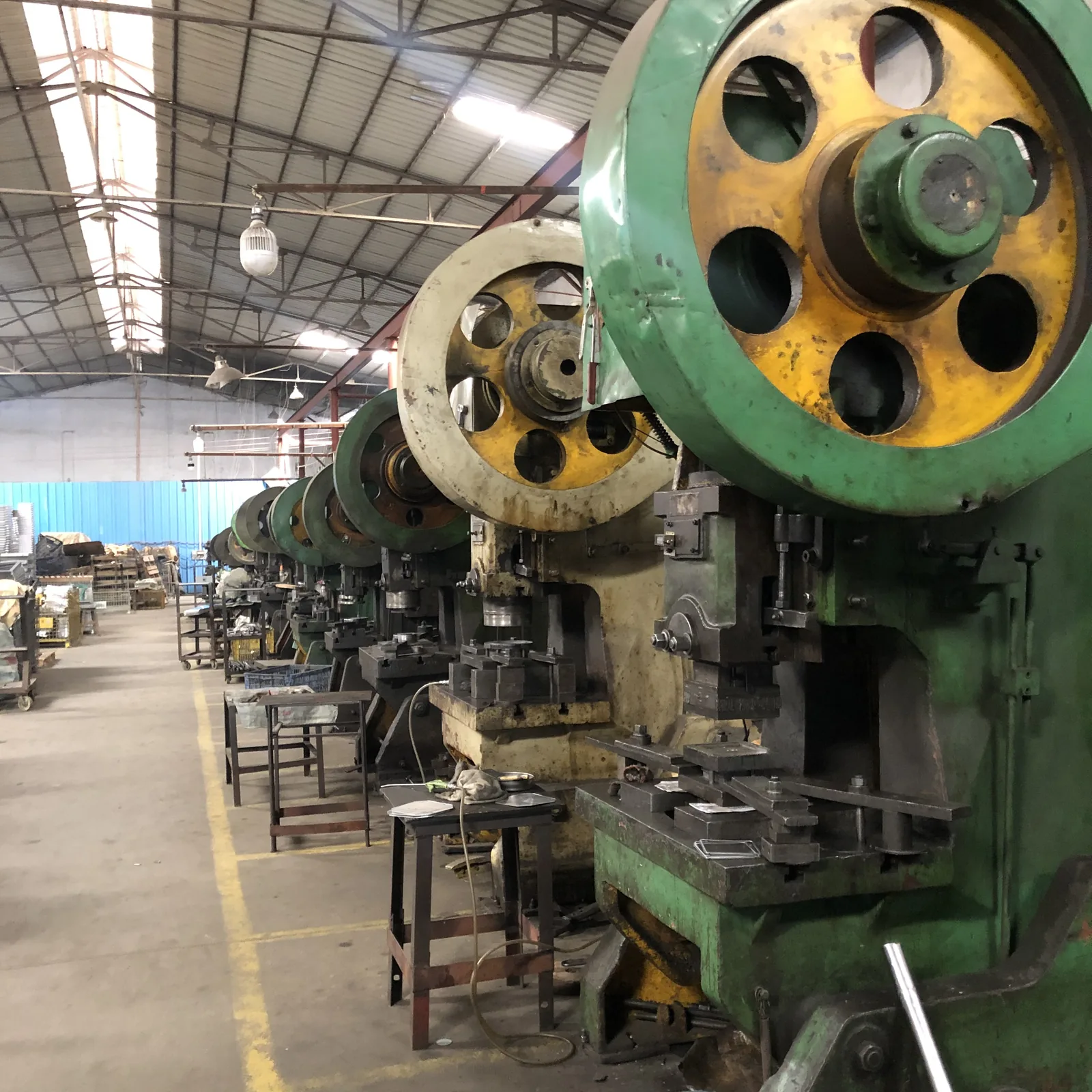
If a supplier says it can meet your specification, ask for evidence tied to the actual process route. For lighting hardware, the right proof usually combines documents, physical controls, and production records.
- First article inspection reports matched to your drawing revision.
- Incoming material inspection records for steel, aluminum, brass, or stainless inputs.
- Gauge calibration records for thread gauges, calipers, coating thickness meters, and test fixtures.
- In-process inspection sheets for stamping, bending, welding, tapping, polishing, plating, or powder coating.
- Salt spray, adhesion, hardness, or coating thickness reports when finish performance matters.
- Packaging standards showing part protection, quantity control, and label traceability.
- Corrective action examples from previous issues, including root cause and preventive action.
For OEM or custom projects, ask the supplier to show how engineering changes are controlled. A reliable factory should be able to explain how revised drawings, sample approvals, tooling updates, and work instructions are released on the shop floor. If this process is vague, production risk rises quickly once volumes increase.
It is also important to separate factory-owned capability from subcontracted capability. Many lighting hardware suppliers outsource plating, anodizing, or specialty finishing. Outsourcing is not automatically a problem, but buyers should confirm who performs the process, how the vendor is approved, and how the final factory verifies outsourced quality before shipment.
A practical buyer checklist for lighting hardware compliance
Before approving a supplier or placing a repeat order, use a structured review instead of relying on general confidence. The checklist below is useful for procurement, SQE, and product teams working together.
| Checkpoint | Status | What to Confirm |
|---|---|---|
| Drawing and revision aligned | Yes / No | Same spec used in quote, sample, and production |
| Critical dimensions identified | Yes / No | Control points visible on inspection plan |
| Finish requirement defined | Yes / No | Color, thickness, test standard, appearance limit |
| Material traceability available | Yes / No | Batch link from raw material to shipment |
| Subcontracted processes disclosed | Yes / No | Plating, coating, heat treatment, polishing listed |
| Nonconformance process reviewed | Yes / No | Segregation, disposition, root cause, CAPA |
| Packaging standard approved | Yes / No | Protection, label format, quantity per carton |
| Pilot run data reviewed | Yes / No | Yield, defect rate, and process stability shown |
This checklist is especially useful when comparing two suppliers with similar pricing. The one with clearer evidence usually creates less downstream cost, even if the unit price is slightly higher.
How to reduce sourcing risk before order confirmation
Before issuing a PO, buyers should close the gap between sample approval and production readiness. In lighting hardware projects, that means confirming not only that the part can be made, but that the factory can hold the process under normal production conditions.
Start by requiring a documented quality agreement or at least a written alignment on critical specifications, finish acceptance, test methods, packaging, and deviation approval rules. This reduces disputes later when defects are found.
Next, ask for a pilot run or pre-production lot when the part includes multiple operations such as stamping, welding, threading, polishing, and coating. A pilot run reveals process variation that a hand-made sample may hide. Review actual measurements, not just pass/fail statements.
Buyers should also confirm lead-time assumptions in detail. If compliance-sensitive finishing is outsourced, ask how much buffer is built into the production schedule, what the backup plan is for rejected finish lots, and whether MOQ pressure could cause batching delays. These are practical sourcing issues that affect delivery performance as much as quality.
Finally, test communication before the order, not after. Send a drawing clarification, tolerance question, or packaging scenario and evaluate the response. Reliable suppliers answer with marked drawings, defined actions, and accountable timelines. Weak suppliers answer with general reassurance. In B2B sourcing, communication quality is often an early indicator of future claims handling.
Conclusion: verify proof, not promises

Strong lighting hardware compliance performance is built on routine factory controls: verified materials, stable processes, finish testing, traceable records, and disciplined response when something goes wrong. Buyers who compare these proof points directly make better supplier decisions and reduce the risk of defects, shipment delays, and avoidable quality cost.
If you are reviewing manufacturing partners for metal lighting accessories or custom hardware programs, the next step is to examine factory capability in detail, compare process controls against your product requirements, and discuss any OEM/ODM or finish-specific expectations with the team. You can continue by reviewing our About Us and Services information to assess sourcing fit and production support scope.
If your project involves finish, tolerance, or custom production questions, the next useful step is to review factory capability overview and lighting hardware sourcing support before finalizing drawings, samples, or mass-production requirements.
 Floor Lamp Sets
 Wall Lamp Sets
 Table Lamp Sets
 Custom Hotel Parts
 Custom Made Parts
 Panels
 Tubes
Tubes Universal joints
 Machined Parts