

-
 Phone:+86 189 2494 9366
-
 E-mail:info@zsshengshi.com
-
 No.5, north of the first road, Guyi Changweiyong manufacturingdistrict, Guzhen, Zhongshan, Guangdong, P.R.C
Factory Capability Proof: QC, Tolerance, and Process Checks Before Sourcing

Key Takeaways: Strong factory capability is not a brochure claim; it should be proven through QC records, tolerance control methods, process checkpoints, and sample consistency. Before placing an order for metal hardware or lighting accessories, buyers should compare measurable evidence such as inspection plans, finish standards, tooling readiness, and communication discipline. A structured pre-order review reduces quality disputes, lead-time slippage, and costly rework.
Introduction: why buyers need proof before they source
In metal hardware and lighting accessories processing, the sourcing risk usually does not start with price. It starts when a supplier says they can hold tolerance, match finish, manage mixed-process production, or scale volume, but cannot show consistent evidence. That is where factory capability becomes a commercial issue, not just a technical one.
Procurement teams and engineers often compare quotations that look similar on paper. The difference appears later: one factory controls burrs, plating thickness, thread fit, and assembly alignment; another depends on operator experience and final sorting. For brackets, housings, stamped parts, threaded fittings, lamp body components, decorative covers, and custom mounting hardware, that difference affects reject rate, installation performance, and downstream customer complaints.
If buyers want sourcing confidence, they need to review how a factory checks incoming material, controls process variation, verifies dimensions, and handles finish approval before mass production. A capable supplier should be able to prove what they do, when they do it, and how they react when results drift out of spec.
Why this decision matters commercially and operationally
A weak supplier evaluation process often creates hidden cost long before a formal quality claim. In this industry, small deviations can create expensive consequences:
- Hole position drift can delay assembly or force manual rework.
- Inconsistent plating or powder coating can cause appearance rejection across one shipment.
- Loose tolerance control on mating parts can create field-fit issues for lighting assemblies.
- Poor process planning can stretch lead time when tooling, polishing, plating, and packing are not aligned.
- Unclear communication on acceptance criteria can turn a routine order into a dispute over what was actually approved.
For procurement, the issue is total supply reliability. For product managers, it is launch timing and customer experience. For engineers, it is process repeatability and fit-for-use. For finance, it is whether the quoted unit price still makes sense after rework, sorting, expediting, and replacement costs are added.
That is why supplier comparison should move beyond “Can they make this part?” to “Can they make it repeatedly, inspect it correctly, and communicate exceptions early?”
Common sourcing mistakes that hide weak capability
Many buyer-side mistakes are not technical; they are comparison mistakes. Teams ask for quotes, review samples, and check lead time, but fail to verify how the supplier controls the process between first sample and full production.
- Comparing price without process scope: one supplier may include in-process checks, fixture control, and finish testing, while another is quoting only fabrication.
- Approving samples without defining acceptance standards: if cosmetic grade, plating thickness, color tolerance, or thread gauge criteria are not documented, sample approval has limited value.
- Assuming CNC or stamping equipment alone proves capability: machine lists do not confirm operator discipline, inspection frequency, or maintenance condition.
- Ignoring MOQ logic: a supplier may accept a low MOQ for trial orders but lack efficient setup control, which raises inconsistency risk.
- Overlooking communication speed and clarity: delayed replies on technical questions usually become delayed escalation during production.
- Failing to review finish control: for visible lighting accessories, finish consistency often causes more rejection than dimensional issues.
The practical lesson is simple: a supplier should not only quote a part; they should explain the process route, quality control points, and likely risk areas before production starts.
What should buyers compare between suppliers?
When comparing factories for metal hardware and lighting accessories, buyers should use a side-by-side framework that combines technical control, production readiness, and commercial reliability. The table below focuses on factors that directly affect sourcing confidence.
| Comparison Point | Strong Supplier Signal | Weak Supplier Signal | Buyer Impact |
|---|---|---|---|
| Tolerance control | Control plan with gauges and records | Verbal promise only | Higher fit and assembly confidence |
| QC checkpoints | Incoming, in-process, final inspection | Final sort only | Lower defect escape risk |
| Finish consistency | Master sample and finish criteria | Visual judgment by batch | Fewer appearance disputes |
| Process transparency | Clear route from material to packing | Unclear subcontracting steps | Better lead-time predictability |
| Engineering response | DFM feedback before sampling | No review of drawing risk | Fewer late-stage changes |
| MOQ flexibility | Explains setup-cost logic | Gives arbitrary MOQ | More realistic trial-order planning |
| Communication discipline | Fast answers with data | Slow and vague replies | Faster issue resolution |
This type of comparison helps buyers avoid a common trap: selecting a supplier based on a successful sample without confirming whether the same result can be maintained under production conditions.
What factory capability evidence should buyers request?

If a supplier claims strong factory capability, buyers should ask for evidence that connects directly to the part being sourced. Generic certifications may be helpful, but they do not replace part-specific proof.
- Inspection plan: what dimensions, cosmetic points, and functional features are checked at incoming, in-process, and final stages.
- Sample inspection report: measured results against drawing tolerances, not just a statement that the sample passed.
- Gauge and fixture method: calipers, thread gauges, custom fixtures, go/no-go gauges, or jigs used to control repeatability.
- Process flow: cutting, stamping, machining, bending, welding, polishing, plating, coating, assembly, and packing sequence.
- Finish approval reference: signed sample, color board, plating thickness requirement, or appearance grading standard.
- Nonconformance handling: how defects are isolated, reviewed, corrected, and prevented in the next run.
- Packaging standard: especially for visible or coated parts that scratch easily during transit.
For lighting accessories, buyers should also confirm whether the supplier has experience with decorative surfaces, visible cosmetic grading, and assembly-critical features such as concentricity, thread engagement, slot alignment, and hole positioning. These are common failure points in production, but they are manageable when the supplier has documented controls.
Practical buyer checklist before placing an order
A short pre-order review can prevent most avoidable sourcing problems. The checklist below is useful for RFQ comparison, sample approval, and purchase-order release.
| Checkpoint | Status | What to Confirm |
|---|---|---|
| Drawing and revision control | Yes/No | Latest approved file and tolerances |
| Material grade confirmation | Yes/No | Base metal, thickness, hardness, finish base |
| Critical dimensions identified | Yes/No | Fit, hole position, thread, flatness, alignment |
| Finish standard approved | Yes/No | Color, texture, thickness, cosmetic grade |
| Inspection method aligned | Yes/No | Sampling plan, gauges, reporting format |
| Tooling and fixture readiness | Yes/No | Tool condition, setup repeatability, maintenance |
| Packaging protection confirmed | Yes/No | Scratch prevention, labeling, carton standard |
| Lead-time breakdown reviewed | Yes/No | Sampling, production, finishing, inspection, shipment |
This framework is especially useful when comparing two suppliers that both appear acceptable. The one that answers these points clearly, with records and named checkpoints, is usually the lower-risk manufacturing partner.
How to reduce sourcing risk before order confirmation
Once a supplier passes initial evaluation, buyers should still close the gap between sample approval and mass production. That is where many projects fail. A practical risk-reduction approach includes the following steps:
- Lock the approved sample: use one physical or photo-documented master reference for dimension, finish, and appearance.
- Mark critical-to-quality features: not every dimension has equal commercial importance. Identify the features that affect assembly, safety, or visible appearance.
- Request a pilot or pre-production run: this is more useful than relying on one hand-built sample.
- Confirm process ownership: ask which steps are done in-house and which are outsourced, especially plating, coating, polishing, and special assembly.
- Align on defect handling: define what happens if finish variation, dimensional drift, or packaging damage is found before shipment.
- Review reporting cadence: for time-sensitive orders, agree on updates for tooling, first article, production start, final inspection, and dispatch.
Buyers should also pay attention to how a supplier communicates bad news. Reliable factories do not wait until the shipping date to report plating delay, fixture wear, or dimension instability. Early escalation is one of the clearest real-world indicators of operational maturity.
In metal hardware and lighting accessories, the best sourcing outcomes usually come from suppliers that combine process discipline with practical engineering discussion. They do not simply accept the drawing. They review it, flag risk points, explain the likely tolerance stack-up, and suggest realistic production controls.
Conclusion: use proof to judge factory capability, not claims
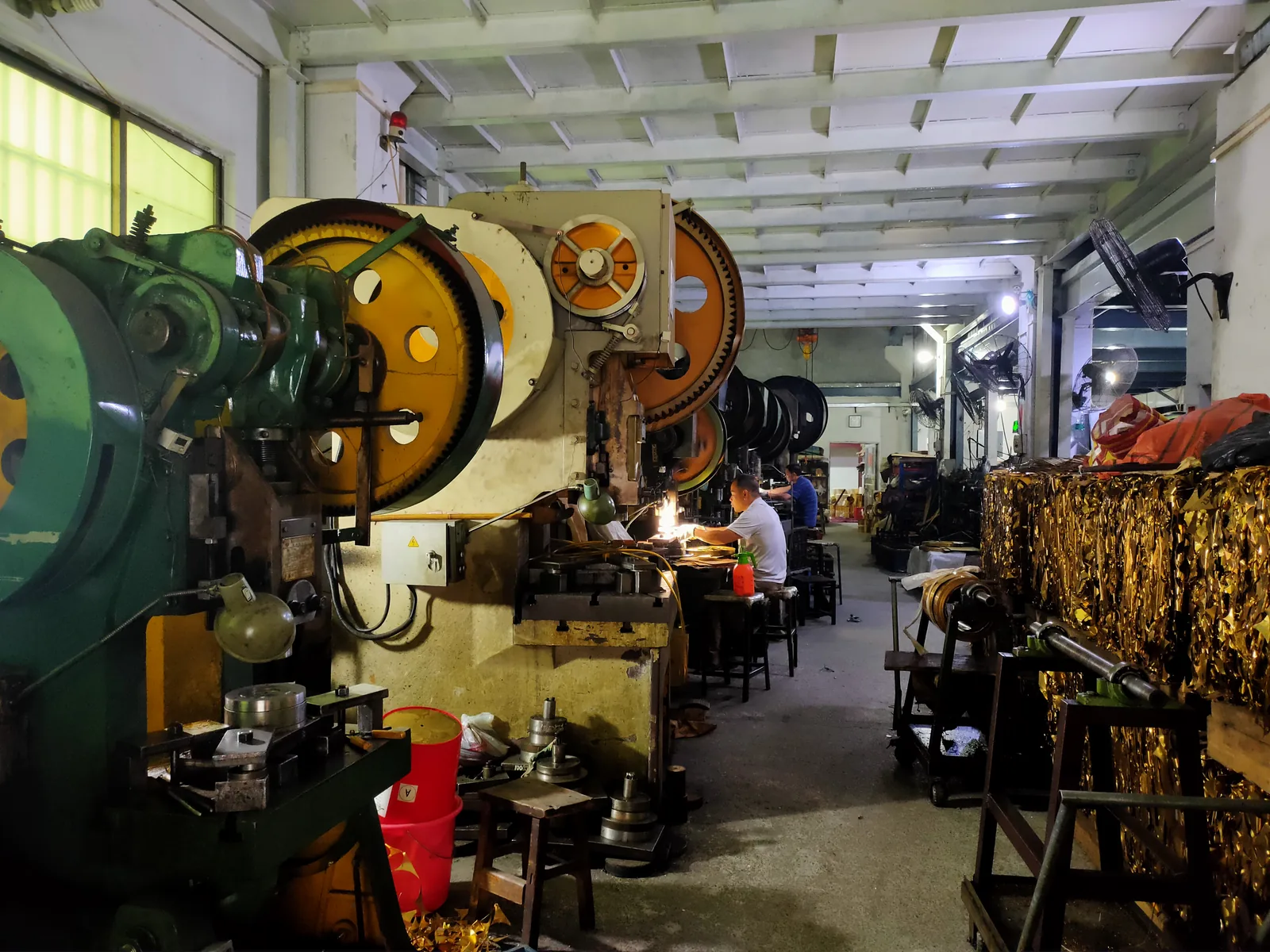
Factory capability should be evaluated through proof: inspection records, tolerance control methods, finish standards, process checkpoints, and clear communication during sampling and production planning. For B2B buyers sourcing metal hardware and lighting accessories, that evidence is what turns a quotation into sourcing confidence.
If you are comparing manufacturing partners, the next practical step is to review the supplier’s relevant production scope, quality controls, and OEM/ODM support in more detail. You can start by reviewing the About Us and Services information, then discuss your drawing, finish expectations, and order requirements with the team before moving to sampling or production.
If your project involves finish, tolerance, or custom production questions, the next useful step is to review factory capability overview and lighting hardware sourcing support before finalizing drawings, samples, or mass-production requirements.
 Floor Lamp Sets
 Wall Lamp Sets
 Table Lamp Sets
 Custom Hotel Parts
 Custom Made Parts
 Panels
 Tubes
Tubes Universal joints
 Machined Parts