

-
 Phone:+86 189 2494 9366
-
 E-mail:info@zsshengshi.com
-
 No.5, north of the first road, Guyi Changweiyong manufacturingdistrict, Guzhen, Zhongshan, Guangdong, P.R.C
Lighting Parts Case Study: Matching Specs to Project Use Cases

Lighting Parts Case Study: Matching Specs to Project Use Cases
Key Takeaways: This lighting parts case study shows that the right component choice depends on where the part will be used, how it will be assembled, and what commercial risks the buyer can accept. Procurement teams should compare suppliers on process capability, finish control, tolerance discipline, MOQ flexibility, and communication speed before approving samples or placing production orders.
A useful lighting parts case study is not just about whether a bracket, housing, ring, tube, or stamped accessory can be made to drawing. For procurement teams and product managers, the real question is whether the supplier can match part specifications to the actual project use case without creating hidden cost, delay, or quality problems later. In metal hardware and lighting accessories processing, a part that works well in one program can fail commercially in another because the assembly method, finish expectation, environment, or order pattern is different.
This is where many sourcing decisions go wrong. Buyers often compare quotations line by line, but not process fit line by line. A low price on a decorative ceiling light canopy may not help if the supplier cannot maintain plating consistency across batches. A factory with strong tube cutting capacity may still be the wrong choice for a wall lamp project that needs cosmetic weld grinding, tight thread engagement, and low-volume custom packaging. Matching specs to project use cases is therefore a factory-selection exercise as much as a technical review.
Why this decision matters commercially and operationally
Lighting parts sourcing affects more than direct unit cost. The wrong supplier-project match can increase total cost through rework, delayed approvals, unstable lead times, excess inventory, or field complaints. For lighting brands, OEM buyers, and contract manufacturers, these issues usually appear after the first approved sample, when production scales and variation becomes visible.
In practical terms, project fit matters in at least four areas:
- Cosmetic quality: visible metal parts must hold finish, color, and surface consistency across multiple lots.
- Assembly efficiency: hole position, thread quality, flatness, and dimensional repeatability affect line-side installation time.
- Supply flexibility: mixed models, low-to-medium MOQs, and engineering changes require responsive planning.
- Compliance and durability: indoor decorative use, damp-location use, and commercial-use environments do not tolerate the same material and finish shortcuts.
For procurement, this means the best supplier is not always the cheapest or the largest. It is often the factory whose process controls, communication habits, and production model fit the buyer’s specific use case.
Common mistakes buyers make when comparing lighting parts suppliers
The most common sourcing mistake is treating all metal lighting parts as interchangeable fabrication work. In reality, a stamped steel mounting plate, a spun aluminum shade, and a brass decorative collar require different process strengths. A supplier may quote all three, but that does not mean all three should be awarded there.
Other weak comparison habits include:
- Approving samples without confirming mass-production control points.
- Comparing only tooling cost and unit price, not finish yield or packaging protection.
- Ignoring the supplier’s subcontracted processes such as plating, powder coating, polishing, or laser welding.
- Assuming MOQ flexibility will continue after pilot orders.
- Not clarifying whether drawing tolerances are functional or cosmetic.
- Failing to define acceptable variation for color, gloss, burrs, weld marks, and thread feel.
These mistakes usually lead to familiar problems: inconsistent finish between orders, unclear lead times during engineering changes, slow corrective-action response, or disputes over whether a defect is cosmetic or functional. Reliable suppliers reduce these risks by asking better questions early, not simply by issuing a faster quote.
What should buyers compare between suppliers for different lighting use cases?
When evaluating suppliers, buyers should compare manufacturing fit against the actual use case, not just the drawing title. The same metal part can have very different sourcing priorities depending on whether it is used in a residential decorative fixture, commercial linear lighting, hospitality custom project, or OEM replacement program.
| Project use case | Key part priority | Supplier strength to verify | Main sourcing risk | Best buyer question |
|---|---|---|---|---|
| Decorative residential fixture | Surface appearance | Polishing and finish consistency | Batch color mismatch | How is cosmetic approval controlled lot to lot? |
| Commercial linear lighting | Dimensional repeatability | Cutting, punching, flatness control | Assembly misfit | What in-process checks protect hole position and straightness? |
| Hospitality custom project | Small-batch flexibility | Engineering response and mixed-order handling | Delay from revisions | How are drawing changes managed after sample approval? |
| Outdoor or damp-location fixture | Corrosion resistance | Material selection and coating validation | Premature rusting | What finish test data supports this environment? |
| OEM spare or repeat parts | Consistency over time | Stable process and document control | Spec drift across reorders | How is the approved baseline preserved for future runs? |
This comparison approach helps buyers separate a generally capable factory from a project-ready factory. The distinction matters because lighting accessories often involve multiple secondary operations, and every secondary operation introduces variation, queue time, and communication risk.
A practical lighting parts case study: same category, different sourcing decisions
Consider two buyers sourcing metal lamp body components. Both request steel tubes, mounting plates, threaded connectors, and decorative covers. On paper, the BOM looks similar. In practice, the supplier decision should not be the same.
Buyer A is launching a mid-range decorative pendant line for retail. The visible metal finish is critical, annual volume is moderate, and packaging must protect polished surfaces from transit scratches. Here, the better supplier is the one with stable polishing standards, plating coordination, cosmetic inspection criteria, and careful packing design. A lower-cost factory with less finish discipline may pass dimensional checks but still create unacceptable visual variation.
Buyer B is building a commercial project line with hidden internal brackets and repeated installation requirements. Appearance matters less than thread accuracy, hole position, and lead-time reliability. In this case, a factory with stronger stamping discipline, fixture-based welding, and documented in-process inspection may be the better fit, even if its decorative finishing capability is basic.
The lesson from this lighting parts case study is simple: the right supplier depends on the failure mode that matters most in the field. Buyers should define that failure mode before requesting final quotations.
What factory capability evidence should buyers request?
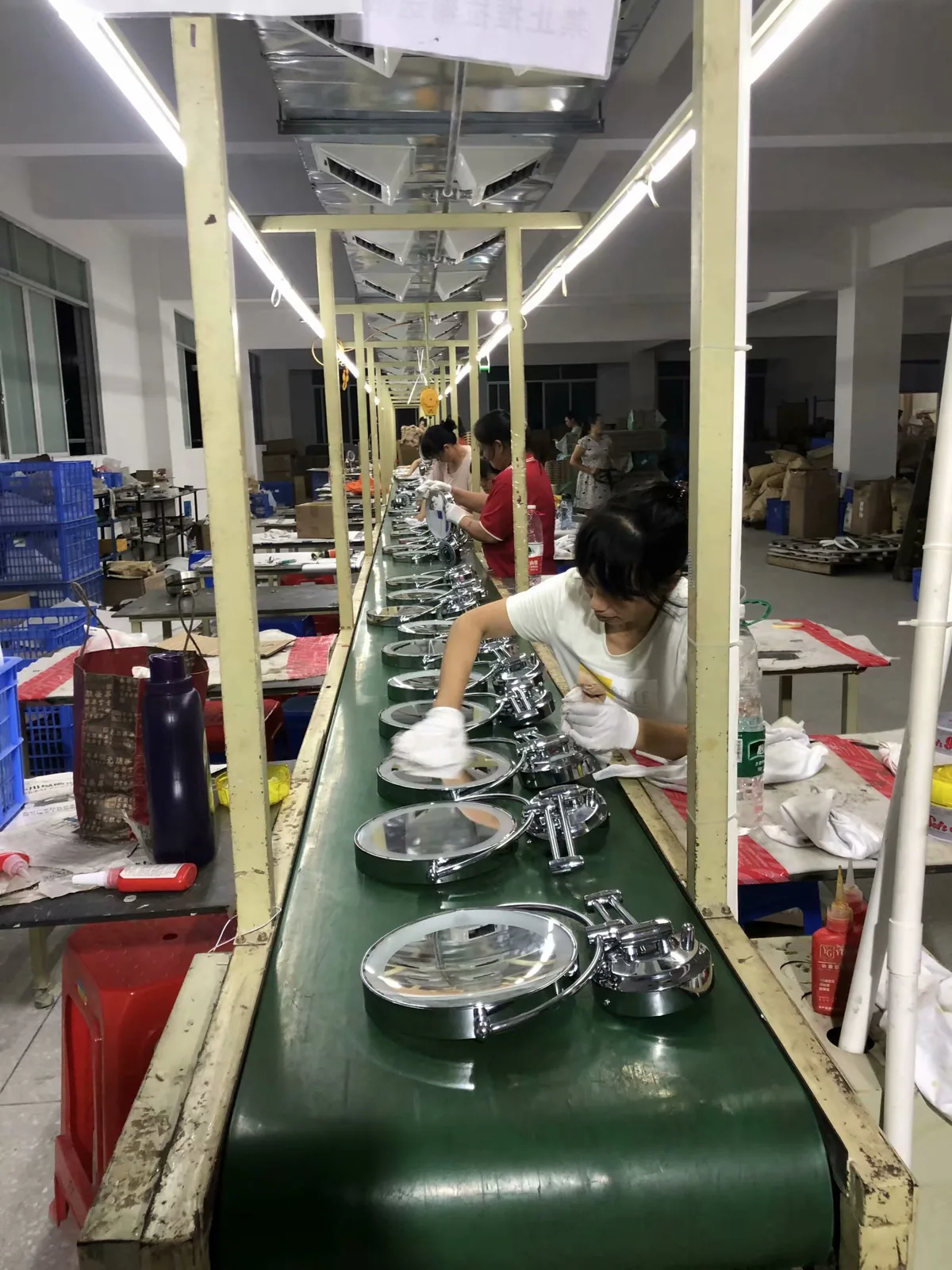
Reliable suppliers should be able to prove capability with evidence, not only claims. This is especially important when a project includes custom metal hardware, cosmetic finishes, or multiple joining methods. Buyers should request evidence that connects directly to the part family being sourced.
- Process flow for the specific part type, including subcontracted steps.
- Sample inspection records showing dimensional and cosmetic checkpoints.
- Photos or videos of relevant equipment, jigs, fixtures, and finishing lines.
- Material certificates or finish specifications tied to the quoted process.
- Packaging method for polished, painted, or plated parts.
- Corrective-action examples for similar defects such as burrs, weld marks, or coating inconsistency.
- Lead-time breakdown from tooling to sample to mass production.
If the supplier cannot provide these items clearly, the buyer should assume there is a gap either in process control or in project management discipline. Strong factories do not need to be perfect, but they should be transparent about what is done in-house, what is outsourced, and where tolerances or finish limitations exist.
| Evidence requested | What it proves | Why it matters | Warning sign |
|---|---|---|---|
| Control plan | Critical checkpoints defined | Reduces mass-production drift | Only final inspection is mentioned |
| Finish samples from past lots | Batch consistency level | Protects cosmetic approval | Only one hand-picked sample |
| Gauge or fixture photos | Repeatability method | Improves assembly fit | Measurement depends on operator judgment |
| Packaging trial | Transit protection readiness | Avoids scratch claims | Packaging decided after production |
Buyer checklist: what to confirm before placing an order
Before issuing a purchase order, buyers should confirm that the quoted solution matches actual production conditions. This checklist is useful for procurement, engineering, and quality teams during final supplier review:
- Has the supplier identified which dimensions are critical to assembly and which are cosmetic only?
- Are material grade, thickness, and finish specification clearly locked?
- Is there written agreement on acceptable cosmetic standards and sample reference pieces?
- Are outsourced processes such as plating, painting, or polishing named and controlled?
- Has the supplier confirmed realistic MOQ, not just trial-order MOQ?
- Is lead time broken into tooling, sampling, approval, and production stages?
- Has packaging been tested for part geometry and finish sensitivity?
- Is there a change-control method for drawing updates and replacement parts?
- Who owns tooling maintenance, replacement timing, and dimensional drift review?
- What is the escalation path if first-batch defects appear?
If several of these points remain open, the buyer is not yet comparing finished offers. They are still comparing assumptions.
How can buyers reduce sourcing risk before order confirmation?
Risk reduction should happen before the first production order, not after a shipment issue. The most effective approach is to align technical review, supplier evaluation, and commercial terms around the intended use case.
A practical sequence is:
- Start with the use environment and assembly method, then review the drawing.
- Classify each part as cosmetic-critical, fit-critical, or cost-critical.
- Ask suppliers to highlight process risks in their own words.
- Approve a golden sample with both dimensional and appearance references.
- Request first-batch inspection data before balance production proceeds.
- Confirm communication timing for engineering changes, quality alerts, and shipment updates.
This process helps buyers catch weak points early: finish inconsistency, unrealistic lead times, loose tolerance interpretation, or unclear subcontractor control. It also improves commercial leverage, because suppliers who understand the project use case tend to quote more accurately and commit more responsibly.
Conclusion: use-case fit should drive supplier selection
The main value of a lighting parts case study is showing that the best sourcing decision comes from matching part specifications to project reality. Buyers should compare factories based on use-case fit, process evidence, finish stability, and execution discipline, not just on unit price or sample appearance. That is how procurement teams reduce rework, avoid supplier-switch costs, and protect launch schedules.
If you are reviewing custom lighting hardware, metal housings, brackets, tubes, or decorative accessories, the next step is to compare service capability against your actual project requirements. You can review the relevant Services scope, or start from the Home overview to discuss OEM/ODM needs, finish expectations, and production-readiness questions with the team.
If your project involves finish, tolerance, or custom production questions, the next useful step is to review main company website and lighting hardware sourcing support before finalizing drawings, samples, or mass-production requirements.
 Floor Lamp Sets
 Wall Lamp Sets
 Table Lamp Sets
 Custom Hotel Parts
 Custom Made Parts
 Panels
 Tubes
Tubes Universal joints
 Machined Parts