

-
 Phone:+86 189 2494 9366
-
 E-mail:info@zsshengshi.com
-
 No.5, north of the first road, Guyi Changweiyong manufacturingdistrict, Guzhen, Zhongshan, Guangdong, P.R.C
How to Specify Project Lighting Hardware for Different Installation Scenarios

How to Specify Project Lighting Hardware for Different Installation Scenarios
Key Takeaways: Specifying project lighting hardware correctly depends on matching the hardware design, finish, load requirement, and installation method to the real site condition, not just the drawing. Buyers should compare suppliers on process control, finish consistency, customization support, and proof of production capability before confirming an order.
For procurement teams and product managers, project lighting hardware is rarely a simple catalog purchase. The same lamp body, bracket, canopy, mounting plate, tube, or decorative metal accessory can perform very differently depending on whether the installation is for a hotel corridor, retail chain, office ceiling, exterior wall, or custom residential project. What looks acceptable in a sample room can become a problem on site if tolerances drift, finishes vary by batch, or mounting points do not match field conditions.
That is why specification work should not stop at dimensions and finish code. Buyers also need to define application scenario, assembly method, installation surface, corrosion exposure, visual standard, packaging requirement, and acceptable production variation. In practical sourcing, the best results come when engineering, purchasing, and the factory align early on how the hardware will actually be used.
Why this decision matters commercially and operationally
In lighting projects, hardware is often a modest share of total unit cost but a major source of delay, rework, and claim risk. If the bracket hole position is off, installers lose time on site. If the plated color shifts between lots, the project may fail visual acceptance. If the wall thickness is underspecified, deformation can appear during assembly or transport. These are not only technical issues; they directly affect project margin, replacement cost, and customer confidence.
Different installation scenarios create different commercial priorities:
- Hospitality projects often prioritize decorative finish quality, repeatability across rooms, and damage-resistant packaging.
- Retail rollouts usually need stable lead times, easy field installation, and consistent appearance across multiple locations.
- Office and commercial fit-outs tend to focus on mounting accuracy, fast assembly, and compatibility with standardized ceilings or walls.
- Outdoor or semi-outdoor applications require stronger attention to corrosion resistance, coating performance, and substrate selection.
- Custom OEM or ODM programs may require prototype speed, drawing support, and disciplined engineering change control.
When buyers compare factories only on quoted price, they usually miss the true cost drivers: finish rework, communication lag, tooling revision, packaging damage, and installation failure. A lower piece price can become a higher project cost very quickly.
Common mistakes buyers make when specifying lighting hardware
Many sourcing problems start with weak comparison habits. The issue is not that buyers lack experience; it is that different teams often evaluate different things. Engineering may focus on drawing compliance, while procurement focuses on unit price and lead time. Without a shared evaluation framework, suppliers are not being compared on equal terms.
The most common mistakes include:
- Using one hardware specification for multiple installation environments without adjusting material or finish.
- Approving a hand-made prototype and assuming mass production will match it exactly.
- Failing to define cosmetic acceptance standards for visible metal parts.
- Not confirming load-bearing, wall thickness, or weld quality for suspended or cantilevered assemblies.
- Ignoring packaging method until after finish approval, which leads to scratches during shipment.
- Comparing suppliers without checking whether they control plating, powder coating, polishing, or outsourced finishing.
- Not locking revision control for drawings, hole positions, and installation interfaces.
A reliable supplier should help identify these gaps before sampling. If a factory only responds to the print without asking about use condition, assembly sequence, finish expectation, or installation substrate, that is usually a warning sign.
What should buyers compare between suppliers for different installation scenarios?
The right supplier for decorative indoor hardware may not be the right one for structural mounting parts or corrosion-sensitive outdoor accessories. Buyers should compare factories based on project fit, not just general manufacturing claims.
| Comparison Area | Indoor Decorative Projects | Commercial Functional Installations | Outdoor or Harsh-Use Projects |
|---|---|---|---|
| Main priority | Surface appearance | Installation accuracy | Corrosion durability |
| Material focus | Brass, steel, aluminum | Steel, aluminum, formed parts | Stainless steel, treated aluminum |
| Critical process | Polishing and plating | Punching, welding, assembly fit | Coating and sealing control |
| Typical risk | Finish inconsistency | Hole mismatch on site | Premature rust or fading |
| Supplier proof needed | Color and cosmetic standard | Dimensional control records | Finish test evidence |
| Packaging concern | Scratch prevention | Part identification | Moisture protection |
This comparison helps buyers ask better questions. For example, a supplier with attractive decorative finishing may still be weak in bracket flatness control or weld consistency. Another factory may have strong fabrication capability but weak cosmetic inspection for customer-facing parts. Project fit matters more than broad capability claims.
How to specify project lighting hardware by installation scenario
A practical specification should reflect the actual installation condition. Below is a useful way to structure the requirement before RFQ or sample review.
| Scenario | What to specify | Main risk | Buyer focus |
|---|---|---|---|
| Wall-mounted fixture | Backplate flatness, hole position, wall clearance | Poor fit on uneven walls | Mounting tolerance and installer feedback |
| Pendant or suspended light | Load capacity, tube straightness, canopy fit | Sagging or unsafe assembly | Structural review and assembly test |
| Ceiling surface mount | Bracket alignment, screw access, service clearance | Slow installation | Ease of field assembly |
| Outdoor decorative light | Base material, coating system, sealing interface | Corrosion and finish failure | Environmental test records |
| Multi-site retail rollout | Part consistency, labeling, pack sequence | Site confusion and shortages | Batch control and logistics readiness |
For each scenario, ask the factory to review not only the drawing but also the installation method. A supplier that understands project use will often suggest changes such as thicker mounting tabs, revised hole spacing, anti-rotation features, improved weld position, or a different finish route to improve consistency.
What factory capability evidence should buyers request?
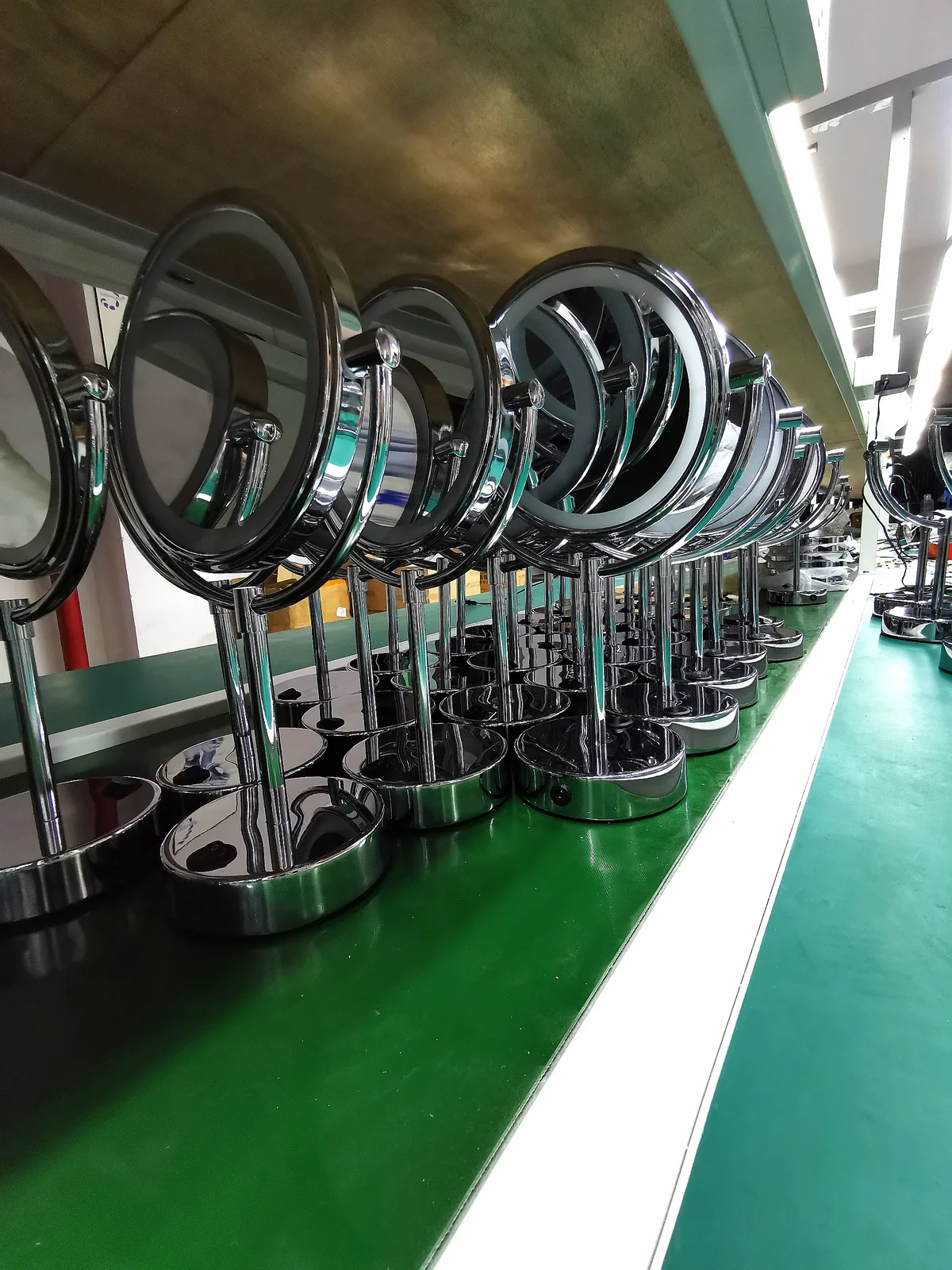
Capability claims should be verified with evidence tied to the part category. Buyers do not need every factory to be vertically integrated, but they do need proof that critical processes are controlled. This is especially important for custom metal lighting accessories where appearance and fit must both be stable.
Request evidence such as:
- Process list by part type: cutting, stamping, CNC machining, bending, welding, polishing, plating, powder coating, assembly.
- Recent production photos or videos of similar hardware, not only showroom samples.
- Inspection records for dimensions, finish checks, and assembly verification.
- Finish test reports or internal standards for adhesion, salt spray, color consistency, or coating thickness where relevant.
- Packaging samples showing how visible parts are protected in transit.
- Engineering support evidence such as DFM feedback, drawing revision control, or prototype improvement history.
- A clear statement of which processes are in-house and which are outsourced.
The most useful proof is specific, recent, and traceable. A reliable supplier should be able to explain how they manage cosmetic inspection, batch identification, outsourced finish vendors, and corrective action if a project issue appears after shipment.
Practical buyer checklist before placing an order
Before releasing a PO, buyers should confirm that commercial terms and technical expectations are aligned. This reduces disputes later, especially on custom or semi-custom project lighting hardware.
| Checkpoint | Why it matters | What to confirm |
|---|---|---|
| Approved drawing revision | Avoids mismatch | Latest signed file and dimensions |
| Material and thickness | Affects strength and cost | Grade, gauge, substitution rule |
| Finish standard | Controls appearance | Sample board, color range, defect limit |
| Assembly and fit test | Reduces site issues | Trial assembly result and photos |
| MOQ and batch plan | Impacts inventory | Minimums by finish or SKU |
| Lead time breakdown | Improves scheduling | Tooling, sample, mass production, finish |
| Packaging standard | Protects finish | Inner wrap, separators, carton mark |
| QC and claim handling | Limits dispute cost | Inspection method and response timeline |
How to reduce sourcing risk before order confirmation
Risk reduction starts before mass production, not after the first complaint. For lighting hardware programs, the most effective approach is to combine technical review with commercial discipline.
First, ask for a pre-production sample made with the intended process, material, and finish route whenever possible. A polished prototype made by hand may not represent production reality. Second, confirm the supplier’s control plan for the most sensitive dimensions and cosmetic surfaces. Third, review packaging with the same seriousness as finish approval. Many appearance claims come from transit damage rather than manufacturing defects.
It is also wise to clarify communication ownership. Buyers should know who handles drawing updates, sample approval, mass production release, and after-sales issues. Slow or fragmented communication is a common cause of missed details, especially when multiple SKUs or installation variations are involved.
If the project has phased delivery or repeated site orders, confirm whether the supplier can maintain finish consistency across batches. This is especially important for brass tones, black coatings, brushed textures, and mixed-material assemblies. A factory that cannot explain lot control and finish matching may create visible differences from one shipment to the next.
Conclusion
Specifying project lighting hardware well means translating the real installation scenario into manufacturing requirements that a factory can control. Buyers should compare suppliers on project fit, finish discipline, dimensional consistency, packaging protection, and communication quality, not only on unit price. That is the difference between a smooth installation and an expensive correction cycle.
If you are reviewing a new lighting program, the next practical step is to compare service capability against your installation scenario, then discuss any OEM or ODM requirements before sampling. You can also review the Home and Services information to align your hardware specification with the right manufacturing approach.
If your project involves finish, tolerance, or custom production questions, the next useful step is to review main company website and lighting hardware sourcing support before finalizing drawings, samples, or mass-production requirements.
 Floor Lamp Sets
 Wall Lamp Sets
 Table Lamp Sets
 Custom Hotel Parts
 Custom Made Parts
 Panels
 Tubes
Tubes Universal joints
 Machined Parts