

-
 Phone:+86 189 2494 9366
-
 E-mail:info@zsshengshi.com
-
 No.5, north of the first road, Guyi Changweiyong manufacturingdistrict, Guzhen, Zhongshan, Guangdong, P.R.C
Custom Hotel Parts for Renovation Projects: Fit, Finish, and Application Guide

Custom Hotel Parts for Renovation Projects: Fit, Finish, and Application Guide
Key Takeaways: Renovation buyers sourcing custom hotel parts need more than attractive samples; they need verified fit, finish consistency, and production control across mixed-use applications such as guest rooms, corridors, bathrooms, and public areas. The best supplier comparison focuses on drawing control, finishing capability, packaging discipline, lead-time reliability, and evidence that the factory can manage repeatable OEM/ODM production at project scale.
Hotel renovation programs rarely fail because a bracket, trim ring, lamp body, metal plate, or decorative hardware item looks wrong in a sample photo. They fail when installed parts do not match site conditions, when finish tones vary between batches, when packaging does not protect cosmetic surfaces, or when the supplier cannot keep pace with phased delivery schedules. That is why sourcing custom hotel parts requires a project-fit mindset rather than a simple unit-price comparison.
For procurement teams, product managers, engineers, and sourcing managers, the key question is straightforward: which factory can produce the required metal hardware or lighting accessory components with reliable fit, stable finish, and practical coordination through pilot, approval, and rollout stages? In renovation work, the answer affects installation speed, rework cost, room downtime, and owner satisfaction.
Why this decision matters commercially and operationally
Renovation projects are less forgiving than new-build programs. Existing walls, legacy electrical layouts, uneven mounting points, and mixed room conditions create tighter tolerances for replacement parts and decorative metal components. A sourcing mistake is not just a purchasing issue; it can delay room turnover, increase site labor, and trigger disputes between contractor, brand team, and owner.
In hotel applications, custom metal hardware and lighting accessories often need to achieve three goals at the same time:
- Fit into an existing installation envelope without major site modification.
- Match the visual standard of the renovated property, including color, gloss, texture, and edge quality.
- Hold up under commercial-use conditions such as frequent cleaning, guest contact, humidity, and maintenance handling.
From a cost perspective, the cheapest quoted part can become the most expensive if it causes field drilling, finish rejection, or partial reshipment. From an operations perspective, a factory with stable engineering review and finishing control can reduce approval cycles and support staggered deliveries by floor, zone, or property group.
Where custom hotel parts are commonly used in renovation projects
Buyers often evaluate suppliers better when they define use case first. Different applications create different risk profiles, especially in metal hardware and lighting accessories processing.
- Guest room lighting components: lamp housings, decorative metal trims, mounting plates, stem parts, brackets, and covers where cosmetic finish and dimensional fit both matter.
- Bathroom accessories: metal holders, mirror hardware, trim pieces, and mounting elements where corrosion resistance and finish durability are critical.
- Corridor and public-area hardware: decorative covers, signage supports, wall-mounted accessory parts, and fixture components where appearance consistency across large quantities matters most.
- Furniture-adjacent metal parts: bedside fixture components, headboard-integrated lighting hardware, and custom brackets where drawings must align with multiple suppliers’ assemblies.
- Retrofit replacement parts: non-standard items made to match legacy dimensions, where reverse engineering and sample validation are more important than catalog breadth.
The right factory for one category may not be the best fit for another. A supplier strong in simple sheet metal fabrication may struggle with decorative plating consistency. A workshop that produces attractive samples may not control mixed-finish batch production for a multi-property rollout.
Common sourcing mistakes in hotel renovation buying
Many comparison errors happen before quotation review. Buyers sometimes send incomplete information, then compare suppliers as if they are quoting the same scope. In reality, one factory may price to a cosmetic standard suitable for hospitality use, while another prices only to basic industrial tolerance.
The most common mistakes include:
- Approving based on photos only instead of signed samples, finish chips, and controlled drawings.
- Comparing unit price without comparing tooling assumptions, finish process, inspection method, and packaging standard.
- Ignoring finish lot consistency for phased deliveries.
- Underestimating MOQ impact when a project needs many variants in small quantities.
- Failing to confirm whether the factory handles OEM/ODM engineering support or only build-to-print production.
- Assuming lead time starts after PO, when in practice it may start only after drawing approval, finish sign-off, and deposit receipt.
- Not clarifying which defects are considered critical, major, or cosmetic in final inspection.
These mistakes create preventable risk. A reliable supplier should help close specification gaps early instead of quietly quoting against assumptions that later become variation claims.
What should buyers compare between suppliers?
For renovation projects, supplier comparison should focus on production readiness, not just quotation speed. The table below gives a practical framework for side-by-side review.
| Criteria | Strong Supplier Signal | Weak Supplier Signal | Buyer Impact |
|---|---|---|---|
| Drawing review | Flags fit risks and missing tolerances | Quotes without technical questions | Higher chance of site mismatch |
| Finish capability | Provides finish samples and process details | Uses generic finish naming only | Risk of color or gloss variation |
| Prototype support | Can sample quickly with revision feedback | Slow or unclear sample process | Delayed approvals |
| MOQ flexibility | Explains MOQ by process and finish | Flat MOQ with no explanation | Poor fit for multi-variant projects |
| Quality control | Has inspection points and records | Relies on final visual check only | More cosmetic and dimensional defects |
| Packaging | Defines protection for visible surfaces | Standard carton only | Transit damage and rework risk |
| Communication | Clear approval trail and issue tracking | Fragmented replies from sales only | Misalignment during production |
| Lead-time control | Separates tooling, sample, and mass production timing | Single broad estimate | Poor schedule predictability |
This comparison is especially useful when several factories appear similar on price. The better commercial decision usually comes from the supplier that reduces downstream uncertainty, not the one that simply offers the lowest first quote.
What factory capability evidence should buyers request?
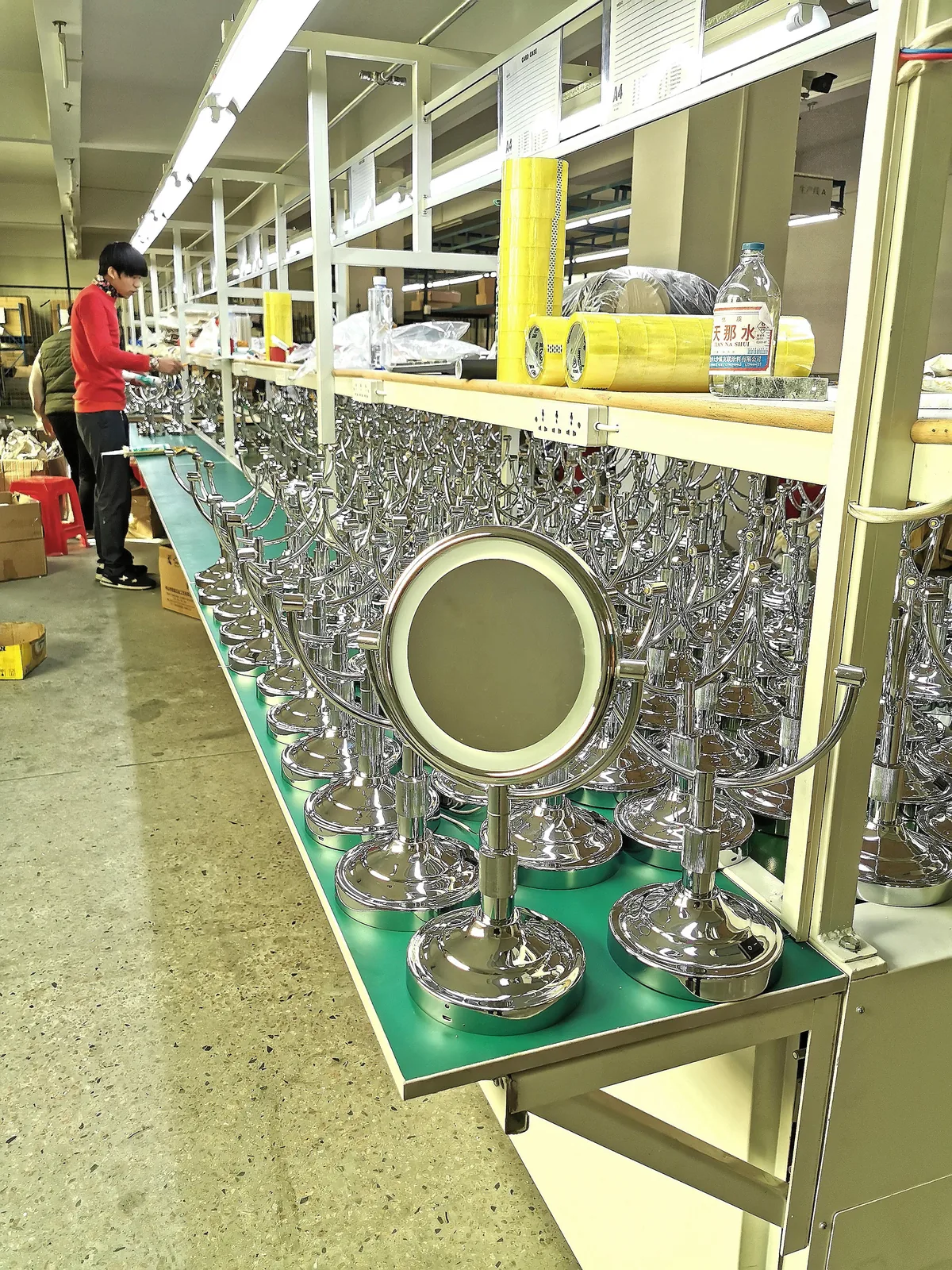
A capable supplier should be able to prove process control with specific evidence. Buyers should not rely on broad statements such as “high quality,” “experienced team,” or “strict QC.” Those phrases have little sourcing value unless backed by documents, samples, and process visibility.
Ask for evidence tied to the exact project type:
- Recent production examples of comparable hospitality or decorative metal parts.
- Material specifications for stainless steel, aluminum, brass, zinc alloy, or sheet metal components used in the quoted scope.
- Finish sample boards showing plating, powder coating, painting, brushing, polishing, or PVD options under consistent reference conditions.
- Dimensional inspection reports for sample parts, especially on mounting interfaces and visible alignment features.
- Photos or videos of relevant in-house processes and key outsourced processes.
- Packaging method for scratch-sensitive decorative parts.
- A sample approval workflow showing how revisions are recorded and released.
- Quality records or control plans for incoming material, in-process checks, and final inspection.
If a factory uses outside finishing partners, that is not automatically a problem. The real question is whether the supplier controls that external process with clear standards, lot tracking, and acceptance criteria. For hotel renovation parts, finish consistency across batches matters as much as the mechanical base part.
Buyer checklist for project fit before placing an order
Before order confirmation, buyers should confirm whether the supplier truly fits the project scenario. The table below can be used as a practical pre-PO checklist.
| Checkpoint | Confirmed? | Why it matters |
|---|---|---|
| Final drawing revision signed by both sides | Yes / No | Prevents version confusion |
| Material grade defined | Yes / No | Affects durability and cost |
| Finish standard approved by sample | Yes / No | Reduces cosmetic disputes |
| Critical dimensions identified | Yes / No | Protects installation fit |
| Inspection method agreed | Yes / No | Aligns quality expectations |
| Packaging specification approved | Yes / No | Protects visible surfaces |
| Lead time split by stage | Yes / No | Improves schedule planning |
| MOQ and overrun tolerance defined | Yes / No | Avoids quantity disputes |
| Change-control contact person assigned | Yes / No | Speeds issue resolution |
This framework is simple, but it helps buyers separate suppliers that are commercially convenient from suppliers that are operationally prepared.
How to reduce sourcing risk before order confirmation
Risk reduction starts with controlled approvals. For hotel renovation parts, there is usually a chain of dependencies: site measurement, drawing confirmation, sample approval, finish approval, packaging confirmation, and then production release. If any step is skipped, later problems become expensive to isolate.
Buyers can reduce risk by taking the following actions:
- Use a golden sample for cosmetic and fit reference, especially when multiple batches or properties are involved.
- Approve finish under realistic lighting, not only office lighting, because hotel interiors make color variation more visible.
- Request pre-production samples from actual tooling or actual process flow when possible.
- Clarify whether replacement demand or future repeat orders will require finish matching months later.
- Confirm whether mixed models can ship together and how the supplier labels cartons for site distribution.
- Define communication timing for engineering changes and non-conformance reporting.
For phased renovation projects, it is also wise to discuss capacity reservation. A supplier may produce acceptable samples but still struggle when multiple SKUs, finishes, and delivery windows overlap. Production planning discipline is often the difference between a smooth rollout and a sequence of partial shortages.
Choosing the right supplier for different buyer scenarios
Not every buyer needs the same type of factory partner. Procurement teams managing repeat branded programs may prioritize finish consistency and replenishment stability. Product managers launching a refreshed room concept may care more about OEM/ODM engineering responsiveness. Contractors handling urgent retrofit work may need a supplier that can reverse engineer from samples and move quickly through pilot runs.
The best sourcing decision comes from matching supplier strengths to the project scenario:
- Brand-standard renovation: prioritize finish repeatability, packaging, and documented change control.
- Value-engineering project: compare material substitutions carefully and confirm where cost savings affect durability or appearance.
- Legacy replacement program: prioritize measurement accuracy, sample validation, and low-volume flexibility.
- Multi-property rollout: prioritize capacity planning, lot traceability, and phased delivery coordination.
In other words, the right partner is the one whose process discipline matches the real application, not the one with the broadest catalog or the fastest sales response.
Conclusion: source custom hotel parts with project-fit discipline
When sourcing custom hotel parts for renovation work, buyers should evaluate fit, finish, and application together. A qualified factory should prove more than manufacturing access; it should show drawing control, finish consistency, quality checkpoints, packaging protection, and communication discipline that supports hospitality project timelines.
If you are comparing manufacturing partners, the next practical step is to review service capability against your specific renovation use case, then discuss OEM/ODM requirements, finish expectations, and order structure before requesting final quotation alignment. You can also review the Home and Services information to see whether the production scope matches your project needs, or contact the team for a focused sourcing conversation.
If your project involves finish, tolerance, or custom production questions, the next useful step is to review main company website and lighting hardware sourcing support before finalizing drawings, samples, or mass-production requirements.
 Floor Lamp Sets
 Wall Lamp Sets
 Table Lamp Sets
 Custom Hotel Parts
 Custom Made Parts
 Panels
 Tubes
Tubes Universal joints
 Machined Parts