

-
 Phone:+86 189 2494 9366
-
 E-mail:info@zsshengshi.com
-
 No.5, north of the first road, Guyi Changweiyong manufacturingdistrict, Guzhen, Zhongshan, Guangdong, P.R.C
Buyer Confidence Checklist for Verifying Factory Proof, QC, and Production Capability

Buyer Confidence Checklist for Verifying Factory Proof, QC, and Production Capability
Key Takeaways: A practical buyer confidence checklist should go beyond price and sample appearance to verify factory proof, process control, and repeatable production capability. For metal hardware and lighting accessories, buyers should compare evidence of tooling control, finishing consistency, QC records, communication discipline, and realistic lead-time capacity before approving an order.
In metal hardware and lighting accessories processing, supplier selection often looks straightforward at the quotation stage and becomes difficult only after production starts. A factory can offer a competitive unit price, respond quickly during sampling, and still fail on finish consistency, packaging discipline, dimensional control, or shipment timing once the order moves into volume production.
That is why a strong buyer confidence checklist matters. Procurement teams, product managers, and engineers need more than a supplier profile or a polished presentation. They need factory proof: evidence that the supplier can repeatedly make the part, control the process, maintain quality standards, and communicate problems before they become cost, delay, or customer-claim issues.
This article focuses on one practical sourcing question: what buyers should verify to confirm real production capability, not just claimed capability. The goal is to support better supplier comparison and stronger order decisions before commercial risk is locked in.
Why this decision matters commercially and operationally
In this industry, many parts are not technically complex in isolation. A stamped bracket, threaded tube, mounting plate, decorative cap, lamp holder component, or custom fastener may appear simple on a drawing. The sourcing risk comes from repeatability across batches, surface treatment stability, assembly fit, and the supplier’s ability to coordinate secondary processes such as polishing, plating, powder coating, tapping, welding, or packaging.
When buyers choose a factory without verifying process proof, the commercial impact appears in several ways:
- Higher total cost due to rework, sorting, replacement shipments, or field failures
- Launch delays caused by tooling correction, unstable first mass production, or missed finishing schedules
- Brand risk from poor cosmetic consistency on visible lighting accessories and decorative hardware parts
- Internal engineering time lost to repeated clarification because drawings, tolerances, or approval standards were not aligned
- Inventory disruption when MOQ, capacity allocation, or lead-time assumptions were not realistic
For buyers managing OEM or ODM projects, confidence should come from documented control points, not from verbal reassurance. A factory that can prove how it manages incoming material, in-process checks, finishing vendors, and final inspection is usually a safer long-term partner than one that only promises flexibility.
Common mistakes buyers make when comparing factories
Weak supplier comparison habits usually start with incomplete criteria. Buyers often compare price, sample look, and lead time, but fail to test whether the factory can sustain those results under production conditions. In metal hardware and lighting accessories, that gap is where most sourcing problems begin.
The most common mistakes include:
- Approving a supplier based on one successful sample without checking process stability
- Assuming surface finish quality is controlled in-house when it is actually outsourced without clear oversight
- Comparing quoted lead times without asking what machine loading or subcontract dependence sits behind them
- Ignoring MOQ logic and later discovering the supplier cannot economically support mixed models or small replenishment runs
- Accepting general QC statements instead of requesting inspection records, gauge control, and defect response procedures
- Failing to clarify critical-to-quality dimensions, cosmetic acceptance standards, and packaging requirements before PO release
- Overlooking communication quality during development, even though it usually predicts execution quality during production
A reliable supplier should not be uncomfortable with detailed verification. If a factory avoids specifics on tooling ownership, process flow, quality records, or subcontractor management, buyers should treat that as a sourcing signal, not a minor issue.
What should buyers compare between suppliers?
A practical comparison should test whether each supplier can meet the actual business requirement: not only make the part, but make it consistently, on time, at the required finish level, and with manageable commercial terms. The table below gives a side-by-side framework buyers can use during RFQ and supplier review.
| Criteria | Supplier A Signal | Supplier B Signal | Buyer Interpretation |
|---|---|---|---|
| Drawing review | Raises tolerance questions early | Quotes without comments | Early questions usually indicate stronger engineering review |
| Process ownership | Core forming in-house | Mostly subcontracted | More in-house control usually means better schedule visibility |
| Finish control | Provides plating test records | Only sends finish photos | Records matter more than appearance alone |
| QC system | Shows IPQC and final reports | States 100% inspection | Documented control beats vague inspection claims |
| Lead time basis | Explains machine and finish schedule | Gives standard promise only | Transparent planning is more credible |
| MOQ flexibility | Explains cost breakpoints | Gives fixed MOQ only | Cost logic helps forecasting and replenishment planning |
| Communication | Replies with action points | Replies with general assurances | Execution quality often follows communication quality |
This type of comparison helps procurement teams avoid a common trap: selecting the supplier that looks easiest during quotation rather than the supplier most likely to perform during production.
What factory capability evidence should buyers request?
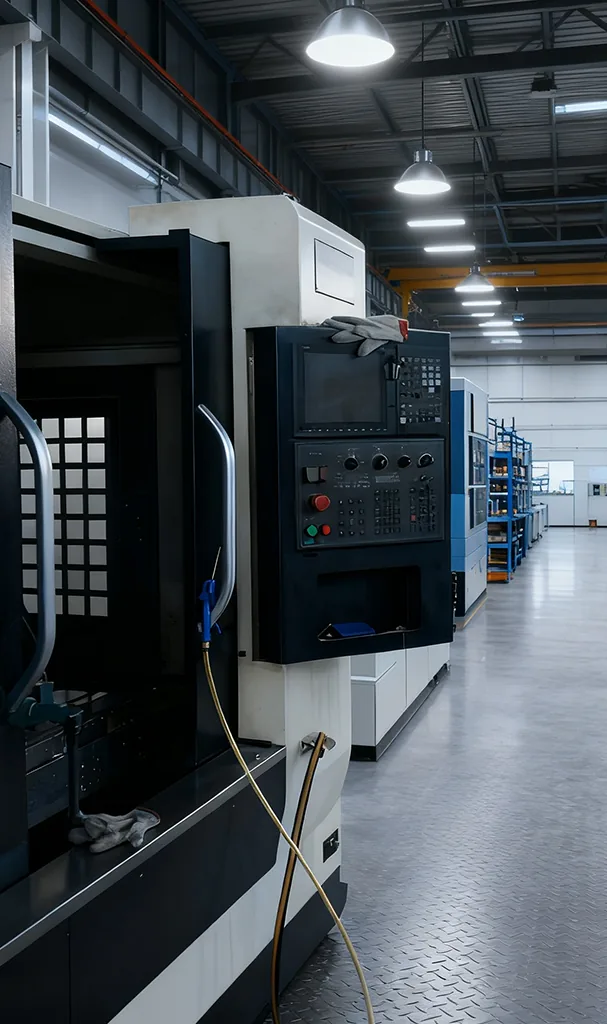
Factory proof should be specific to the part family and process route. In metal hardware and lighting accessories, buyers should request evidence linked to forming, machining, welding, threading, polishing, plating, coating, assembly, and packaging as applicable. Generic capability decks are not enough.
Useful capability evidence includes:
- Process flow chart for the quoted part or a similar product family
- Machine list with relevant tonnage, capacity, or dimensional range
- Tooling photos or tooling management method for stamped, cast, or machined components
- First article inspection report or sample dimensional report
- In-process QC checkpoints and final inspection format
- Surface finish verification records such as thickness, adhesion, salt spray, or color consistency checks when relevant
- Packaging specification examples for cosmetic or export-sensitive parts
- Corrective action examples showing how defects were traced and closed
- Production photos or videos that show actual line conditions, not showroom images only
- Subsupplier control method for outsourced plating, anodizing, powder coating, or polishing
For lighting accessories, finish consistency is often as important as dimensional compliance because visible components directly affect end-product appearance. Buyers should therefore ask how the factory manages batch-to-batch color variation, scratch prevention, hanging marks, and mixed-lot packaging. For hardware parts with assembly function, buyers should ask how thread quality, fit-up tolerance, burr control, and flatness are verified before packing.
The strongest suppliers usually provide evidence in a structured way. They can explain which operations are in-house, which are external, where quality gates sit, and what records are available if a claim occurs later.
A practical buyer confidence checklist
The checklist below is designed for pre-order supplier validation. It can be used by procurement, engineering, and quality teams together so commercial approval is tied to production reality.
| Checkpoint | Status | What to Verify |
|---|---|---|
| Drawing and specification review completed | Yes/No | Critical dimensions, finish, packaging, and test standards aligned |
| Quoted process route confirmed | Yes/No | In-house vs outsourced operations clearly identified |
| Sample linked to production method | Yes/No | Sample made by real process, not temporary manual method |
| QC documents reviewed | Yes/No | Inspection format, frequency, gauges, and acceptance criteria available |
| Finish capability verified | Yes/No | Coating or plating records match required appearance and durability |
| Capacity and lead time checked | Yes/No | Lead time based on actual loading, not only sales estimate |
| MOQ and replenishment logic understood | Yes/No | Order economics support forecast and after-launch needs |
| Communication owner assigned | Yes/No | Commercial, engineering, and quality contacts are defined |
| Packaging standard approved | Yes/No | Carton, inner protection, labeling, and pallet rules confirmed |
| Claim and corrective action path agreed | Yes/No | Response time, traceability, and replacement responsibility defined |
If several items remain unclear, the buyer should not treat the supplier as fully approved, even if pricing is attractive. Confidence is earned when proof is complete enough to support repeat orders, not just an initial trial.
How to reduce sourcing risk before order confirmation
Before placing an order, buyers should convert assumptions into confirmed controls. This is especially important for custom hardware and lighting accessory programs where cosmetic standards, assembly fit, and packaging quality can be just as important as nominal dimensions.
A practical pre-order risk reduction approach includes four steps:
- Lock the approved reference: drawing revision, finish standard, approved sample, and packaging method should all match the PO basis
- Define the inspection plan: clarify critical dimensions, cosmetic zones, defect thresholds, and any required functional checks
- Test the communication path: confirm who handles engineering changes, production updates, and quality claims during mass production
- Start with a controlled first order: where possible, use a pilot quantity or first production review before scaling to larger volume
Buyers should also pay close attention to how the supplier discusses risk. Reliable factories usually identify process-sensitive points openly: weld deformation, plating color drift, thread damage after coating, scratch risk during packing, or tolerance stack-up in assemblies. This is a positive sign. Suppliers that present every requirement as easy may still be at the quotation stage mentally, not the production stage operationally.
If the project includes OEM or ODM work, the buyer should additionally confirm design responsibility boundaries. Who validates manufacturability? Who owns tooling modification cost? Who approves substitute materials or process changes? These points are often overlooked until the first production problem appears.
Conclusion: use a buyer confidence checklist before you commit
A dependable sourcing decision in metal hardware and lighting accessories should be based on evidence, not optimism. The right buyer confidence checklist helps teams compare suppliers on proof of process, QC discipline, finish control, communication quality, and realistic production capability. That creates better pricing context, fewer surprises after PO release, and stronger confidence in long-term supply.
If you are reviewing potential manufacturing partners, the next useful step is to compare actual production and quality capabilities against your product requirements, not just quotation terms. You can review our About Us and Services information to understand available process support, OEM/ODM collaboration, and production readiness, or start a sourcing conversation with our team to discuss your part requirements in more detail.
If your project involves finish, tolerance, or custom production questions, the next useful step is to review factory capability overview and lighting hardware sourcing support before finalizing drawings, samples, or mass-production requirements.
 Floor Lamp Sets
 Wall Lamp Sets
 Table Lamp Sets
 Custom Hotel Parts
 Custom Made Parts
 Panels
 Tubes
Tubes Universal joints
 Machined Parts