

-
 Phone:+86 189 2494 9366
-
 E-mail:info@zsshengshi.com
-
 No.5, north of the first road, Guyi Changweiyong manufacturingdistrict, Guzhen, Zhongshan, Guangdong, P.R.C
How to Match Commercial Lighting Hardware to Project Use Cases and Site Conditions

Key Takeaways: Choosing the right commercial lighting hardware depends on more than appearance or unit price. Buyers should match hardware design, material, finish, mounting method, and factory capability to the actual use case, installation environment, and service-life requirement. Strong supplier selection comes from comparing proof of process control, finish consistency, lead-time reliability, and customization readiness before order confirmation.
For procurement teams and product managers, sourcing commercial lighting hardware is rarely a simple component purchase. The same bracket, housing, canopy, clip, arm, or mounting plate may perform well in one project and fail early in another because the site conditions, installation method, load requirement, or finish exposure were not fully considered during sourcing. This is where many commercial projects lose time and margin: the hardware looked acceptable on a drawing, but it was not matched to the real operating environment.
In lighting programs for offices, retail chains, hospitality spaces, public buildings, warehouses, and exterior applications, hardware selection affects assembly efficiency, product stability, corrosion resistance, maintenance frequency, and brand perception. Buyers comparing manufacturing partners should therefore focus less on catalog similarity and more on project fit. A capable factory should be able to explain why one material, fabrication route, or finish system is better suited to a given use case than another.
Why this decision matters commercially and operationally
Lighting hardware is often treated as a support item, but in commercial projects it directly influences installation labor, field failure risk, and after-sales cost. If mounting points are misaligned, tolerances are unstable, or finish durability is below site demand, the cost impact quickly exceeds the original piece-price savings. Rework, delayed installation, replacement freight, and customer complaints are usually far more expensive than choosing the right supplier at the start.
This is especially true when buyers manage rollouts across multiple locations. A retail chain or office fit-out project may require identical visual finish and dimensional consistency across several production batches. Any shift in color tone, gloss, coating adhesion, or hole position can create field-level mismatch. For OEM and ODM buyers, hardware also needs to support smooth downstream assembly with electrical parts, diffusers, drivers, and decorative elements.
From a sourcing perspective, the right decision reduces risk in five areas:
- installation efficiency on site
- finish durability under actual environmental exposure
- batch-to-batch consistency during repeat orders
- lead-time predictability for project milestones
- communication accuracy during custom development
Common mistakes buyers make when matching hardware to use cases
The most common sourcing mistake is comparing suppliers only by drawing compliance and quoted price. Two factories may both say they can produce the part, but one is using a process route that is stable for the application while the other is stretching capability. Buyers should assume that “can make” and “can make reliably for this project” are different things.
Other weak comparison habits include:
- specifying finish color but not corrosion-performance expectation
- approving samples without reviewing load, vibration, or mounting stress conditions
- ignoring packaging protection for coated or polished surfaces
- choosing low MOQ suppliers that cannot hold repeat-order consistency
- failing to confirm secondary processes such as tapping, welding cleanup, polishing, or assembly inspection
- assuming indoor hardware can be used in semi-outdoor or humid environments
In practical terms, a decorative pendant fixture for a hotel lobby, a linear light for office ceilings, and a wall-mounted exterior fixture may all use metal hardware, but they should not be sourced with the same decision logic. The environmental load, visual expectation, and maintenance access are different, so the hardware specification and supplier fit should be different as well.
What should buyers compare between suppliers for different project scenarios?
A more reliable comparison starts with the project use case, then moves backward into material, process, finish, tolerance, and factory controls. Buyers should ask suppliers to recommend a process path based on the site condition rather than simply quoting the print. That response often reveals whether the supplier understands the application or is only pricing the drawing.
| Project scenario | Hardware priority | What to confirm | Typical sourcing risk |
|---|---|---|---|
| Office interiors | Dimensional consistency | Hole position, assembly fit, finish uniformity | Visible mismatch across batches |
| Retail rollout | Repeatability at scale | Capacity, batch control, packaging | Late deliveries during multi-site launch |
| Hospitality decorative lighting | Surface appearance | Polishing standard, plating quality, scratch protection | Finish inconsistency under lobby lighting |
| Warehouse or industrial use | Strength and secure mounting | Load support, weld quality, bracket rigidity | Field loosening or deformation |
| Semi-outdoor or humid areas | Corrosion resistance | Base material, coating system, test evidence | Early rust, blistering, coating failure |
Buyers should also compare the supplier’s recommended manufacturing route. For example, sheet metal stamping may be cost-efficient for stable, high-volume geometries, while CNC machining may be more suitable for low-volume precision parts or rapid design iteration. Welding capability matters when structural integrity is important, but weld appearance and post-processing control matter more when hardware remains visible in decorative fixtures.
| Comparison point | Supplier A signal | Supplier B signal | Buyer interpretation |
|---|---|---|---|
| DFM feedback | Suggests design improvement | Quotes only | A is more application-aware |
| Finish evidence | Provides test records | Provides color sample only | A is stronger for durability-critical use |
| Lead-time planning | Tooling and batch schedule shown | General promise | A is more predictable |
| MOQ flexibility | Pilot run possible | High MOQ only | A fits new product validation |
| Communication quality | Clarifies critical dimensions | Assumes drawing is complete | A lowers error risk |
What factory capability evidence should buyers request?
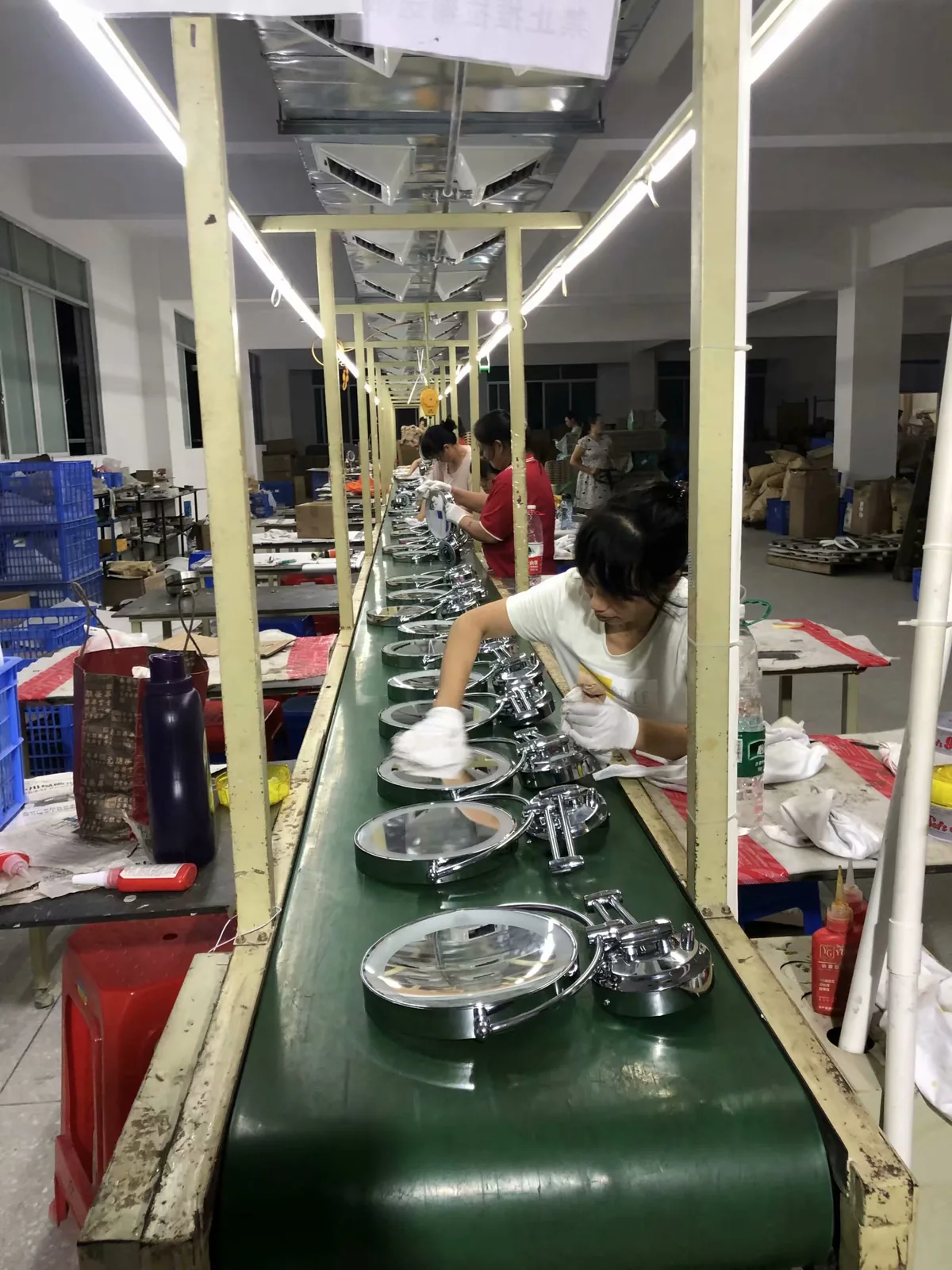
If the project involves custom or semi-custom commercial lighting hardware, buyers should request evidence that the factory can control both fabrication and finishing for the intended application. A polished sample alone is not enough. The supplier should prove process stability, not just sample-making ability.
Useful evidence includes:
- material certificates for steel, stainless steel, aluminum, brass, or other specified metals
- process flow chart covering cutting, stamping, bending, welding, machining, polishing, coating, and inspection
- photos or records of relevant tooling, fixtures, and inspection gauges
- finish test data such as adhesion, salt spray, thickness, or color consistency checks when applicable
- sample inspection reports with critical dimensions highlighted
- packaging method for scratch-sensitive or plated components
- repeat-order control method for color, gloss, and assembly fit
For buyers evaluating OEM/ODM readiness, it is also important to see whether the supplier can support design-for-manufacturing feedback early. A reliable factory should be able to flag weak weld access, impractical bend radii, unstable thread depth, coating build-up issues, or cosmetic risks before tooling or mass production begins.
Practical checklist for matching hardware to project fit
Before shortlisting a supplier, procurement and engineering teams can use the following framework to confirm whether the proposed hardware is aligned with the real project conditions.
- Use environment: indoor, humid, exterior, high-traffic, vibration-prone, or decorative focal area
- Mechanical need: load-bearing, suspension, wall mounting, concealed support, or adjustment function
- Visual standard: functional finish, architectural finish, brushed, polished, powder coated, plated, or custom color
- Production mode: pilot run, recurring batch, rollout program, or long-term standard part
- Assembly interface: fit with drivers, housings, lenses, diffusers, fasteners, and cable routing
- Tolerance risk: hole position, flatness, thread quality, weld distortion, and mating-part compatibility
- Logistics requirement: nested packing, label control, kitting, and site-ready packaging
- Commercial requirement: MOQ, tooling ownership, lead time, engineering response speed, and change control
This checklist helps prevent a common problem in lighting projects: the hardware is technically manufacturable, but not commercially practical for the program. The right supplier should fit both the technical requirement and the ordering model.
How to reduce sourcing risk before order confirmation
Before issuing a purchase order, buyers should convert assumptions into documented confirmations. This is where many avoidable disputes can be eliminated. If a requirement matters in the field, it should be written into the approval and production record.
At minimum, confirm the following:
- approved drawing revision and critical dimensions
- material grade and thickness tolerance
- finish specification, color reference, and acceptance standard
- sample approval status and whether the mass-production sample matches the quoted process
- inspection method for cosmetic and dimensional checks
- lead time split between tooling, sample, pilot run, and mass production
- MOQ by part number, finish, and packaging configuration
- non-conformance handling and replacement process
For new product launches, a pilot order is often the best risk-control step. It allows buyers to verify finish consistency, packing protection, assembly fit, and communication quality before committing to large-volume production. This is particularly useful when the project includes multiple finishes, mixed hardware sets, or site-specific customization.
Buyers should also pay attention to communication discipline. Reliable suppliers do not simply accept every note without comment. They ask clarifying questions, identify missing tolerances, and document deviations. That behavior usually signals stronger control during production.
Conclusion: choose commercial lighting hardware by project reality, not by catalog similarity
The best sourcing decisions for commercial lighting hardware come from matching hardware type, metal process, finish system, and supplier capability to the actual project environment and installation demand. Buyers who compare factories on application fit, proof of control, and repeat-order reliability usually reduce total project cost more effectively than buyers who focus only on initial unit price.
If you are reviewing a new lighting project or comparing manufacturing partners, the next practical step is to review relevant service capability, compare process options for your hardware category, and discuss OEM/ODM requirements with a factory team that can evaluate site conditions and production fit in detail. You can also start from the Home or Services pages to narrow the right manufacturing scope before moving into drawings and samples.
If your project involves finish, tolerance, or custom production questions, the next useful step is to review main company website and lighting hardware sourcing support before finalizing drawings, samples, or mass-production requirements.
 Floor Lamp Sets
 Wall Lamp Sets
 Table Lamp Sets
 Custom Hotel Parts
 Custom Made Parts
 Panels
 Tubes
Tubes Universal joints
 Machined Parts