

-
 Phone:+86 189 2494 9366
-
 E-mail:info@zsshengshi.com
-
 No.5, north of the first road, Guyi Changweiyong manufacturingdistrict, Guzhen, Zhongshan, Guangdong, P.R.C
Sourcing Risk Control: What to Compare Before Approving a Supplier

Sourcing Risk Control: What to Compare Before Approving a Supplier
Key Takeaways: Effective sourcing risk control starts before the first PO, not after the first quality issue. Buyers should compare suppliers on process capability, finish consistency, communication discipline, lead-time realism, and proof of production control—not only on price. A reliable factory should be able to show objective evidence that it can meet your specification repeatedly, not just promise that it can.
In metal hardware and lighting accessories processing, supplier approval is rarely a simple price decision. Procurement teams may receive similar quotations from multiple factories, yet the actual supply risk behind those quotes can vary widely. One supplier may have better stamping control but weak surface finishing management. Another may offer a lower unit price but rely on unstable subcontractors for plating, powder coating, or polishing. A third may communicate well during sampling but struggle to maintain lead time once production slots tighten.
That is why sourcing risk control should be built into the supplier comparison stage. Before approving a supplier, buyers need to compare not only commercial terms, but also manufacturing fit, quality discipline, process ownership, and responsiveness under real production conditions. This is especially important for OEM and ODM projects where dimensional tolerance, assembly fit, cosmetic finish, and packaging consistency all affect downstream delivery performance.
Why this decision matters commercially and operationally
A weak supplier approval decision creates costs far beyond the quoted unit price. In hardware and lighting accessory programs, a supplier mismatch can lead to repeated sample revisions, finish shade variation across batches, late material readiness, unexpected MOQ pressure, and rework at incoming inspection or assembly. These issues do not stay inside the factory. They affect launch timing, inventory planning, customer commitments, and margin.
For procurement, the commercial impact shows up in expediting charges, duplicate qualification work, and hidden supplier management time. For engineering, it appears as dimension drift, inconsistent threading, poor weld appearance, burr problems, or coating adhesion failures. For product managers, it becomes a launch risk. For operations, it becomes a schedule risk.
The practical takeaway is simple: the cheapest supplier is often the most expensive supplier to recover from if its process controls are weak. Approval should therefore be based on total execution reliability, not quotation alone.
Common mistakes buyers make when comparing suppliers
Many supplier comparisons fail because buyers compare what is easy to collect instead of what predicts production performance. In this industry, the most common weak comparison habits include:
- Comparing unit price without separating raw material cost, processing cost, tooling cost, and finish cost.
- Approving based on a good sample while ignoring whether the sample was hand-selected or produced under normal batch conditions.
- Accepting broad statements like “we can do it” without asking which process steps are in-house and which are outsourced.
- Failing to confirm tolerance control, cosmetic standards, and acceptance criteria before quotation approval.
- Ignoring communication speed and technical clarity during RFQ and sample review.
- Underestimating MOQ, setup loss, and color or finish batch variation for plated or coated parts.
- Not checking whether the supplier has capacity discipline during peak season.
These mistakes are common because they are easy to make under deadline pressure. But they reduce decision quality. A supplier that looks competitive on paper may still be a poor fit for low-volume custom runs, high cosmetic requirements, or mixed-SKU production.
What should buyers compare before approving a supplier?
The best supplier comparisons focus on repeatability. Buyers should compare whether each factory can produce the required part, finish it consistently, inspect it reliably, communicate deviations early, and ship on the promised timeline. The table below shows a practical comparison structure for hardware and lighting accessory sourcing.
| Comparison Item | What Strong Suppliers Show | Warning Signs | Buyer Checkpoint |
|---|---|---|---|
| Process fit | Clear match to stamping, CNC, bending, welding, casting, or assembly needs | General capability claims only | Ask which steps are in-house and which are outsourced |
| Drawing review | Identifies tolerance, burr, finish, and assembly risks early | No technical questions raised | Check whether DFM feedback is specific and useful |
| Finish consistency | Controls color, gloss, adhesion, and lot traceability | Only visual promise, no standard reference | Confirm approved sample, finish code, and acceptance range |
| Quality control | Incoming, in-process, and final inspection records available | Relies only on final inspection | Request control plan and sample inspection report |
| Lead time control | Explains material lead time and production scheduling logic | Promises fast delivery without breakdown | Verify standard lead time and peak-season capacity |
| MOQ flexibility | Explains MOQ by process, material, and finish setup | MOQ changes after quotation | Confirm trial order and repeat-order MOQ separately |
| Communication discipline | Fast, technical, and documented responses | Slow replies or vague answers | Evaluate response quality during RFQ and sample stage |
| Change management | Controls revision history and approval records | Uses latest drawing “by message” only | Confirm version control before tooling or PO release |
This type of side-by-side comparison helps buyers avoid overvaluing a low quote that sits on weak process control. In practice, the strongest suppliers are often the ones that ask the best technical questions before production begins.
What factory capability evidence should buyers request?
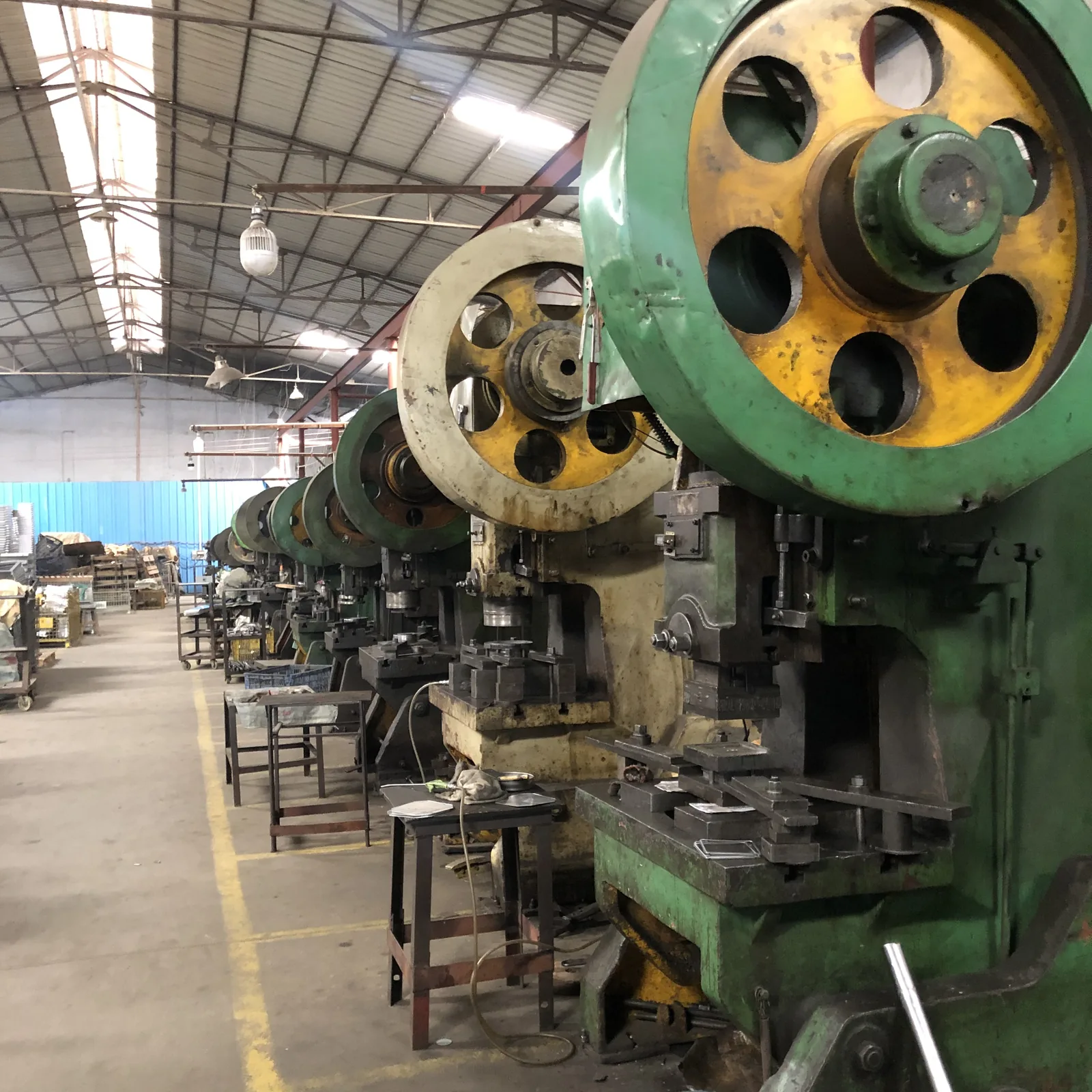
A reliable supplier should be able to prove capability with evidence, not sales language. For metal hardware and lighting accessories, buyers should request proof tied directly to the part family and process route involved.
Useful capability evidence may include production photos or videos of similar processes, sample inspection reports, dimensional records, finish test results, packaging standards, and a basic process flow showing where each operation happens. If the supplier claims in-house stamping, welding, polishing, coating, or assembly, that should be visible in its documentation and reflected in its lead-time logic.
| Evidence Requested | Why It Matters | What Buyers Should Look For |
|---|---|---|
| Inspection report | Shows tolerance control discipline | Measured dimensions tied to drawing points |
| Finish test record | Reduces coating and plating risk | Adhesion, salt spray, color or gloss reference |
| Process flow | Clarifies process ownership | In-house vs outsourced steps clearly marked |
| Similar project reference | Shows actual category experience | Comparable material, finish, and complexity |
| Packaging standard | Prevents transit and scratch damage | Part separation, labeling, carton logic |
If a supplier cannot provide this kind of evidence during evaluation, buyers should assume the production system may be less mature than claimed. That does not always mean the factory is unsuitable, but it does mean the approval decision should be more cautious and the first order should be more tightly controlled.
A practical supplier evaluation checklist for procurement teams
To keep supplier approval disciplined, use a simple pre-approval framework. The goal is not to create paperwork for its own sake, but to make sure the same risks are checked each time.
- Has the supplier reviewed the latest drawing, BOM, finish requirement, and packaging standard?
- Did the supplier identify any tolerance, assembly, or surface-finish risks before quoting?
- Are key operations in-house, and if not, are outsourced steps controlled?
- Has the supplier provided a realistic lead time with material and finish assumptions?
- Are MOQ, tooling charges, sample charges, and repeat-order terms clearly stated?
- Is there an agreed approved sample or finish reference standard?
- Can the supplier provide inspection records for critical dimensions and cosmetic checkpoints?
- Is there a named project contact who can coordinate engineering, production, and shipment updates?
- Are revision control and change approval methods defined before PO release?
- Has the first-order risk plan been agreed, including sample signoff, pilot quantity, and final inspection method?
This checklist is especially useful when comparing two suppliers that appear similar on price. The supplier that answers clearly, documents assumptions, and flags risks early is often the safer long-term partner.
How to reduce sourcing risk before order confirmation
Before placing the first order, buyers should convert assumptions into confirmed controls. This is where many sourcing programs become exposed. The quotation may be approved, but key details remain open: finish tolerance, allowable cosmetic defects, packaging method, labeling, thread gauge requirements, or whether sample quality actually represents batch production.
A practical risk-control approach is to slow down slightly before the first PO so the production run moves faster later. Confirm the exact drawing revision, finish code, color reference, sample approval status, inspection points, and shipment terms. If the part is cosmetic or customer-facing, define what counts as acceptable appearance under normal inspection conditions. If the project includes multiple SKUs or mixed finishes, verify how the factory will segregate and label them.
For new suppliers, many buyers reduce risk by using a staged approval path: sample approval first, then a pilot order, then a larger release after performance review. This approach is especially effective for custom brackets, lamp body accessories, decorative metal parts, mounting hardware, and assemblies with outsourced finishing. It gives both sides a chance to validate process stability before volume exposure increases.
It is also important to test communication under pressure. Ask how the supplier handles nonconforming material, finish rework, schedule slippage, or engineering changes after tool release. Reliable factories do not claim that problems never happen. They explain how issues are escalated, contained, corrected, and reported.
Conclusion: approve suppliers based on control, not promises
Good sourcing risk control is not about eliminating every uncertainty. It is about approving suppliers based on evidence, process fit, and execution discipline before those uncertainties become expensive. In metal hardware and lighting accessories processing, buyers should compare process capability, finish control, inspection practice, communication quality, MOQ logic, and lead-time realism as a single decision package.
If you are comparing manufacturing partners for custom hardware or lighting accessory projects, a useful next step is to review relevant Services capability and prepare a detailed RFQ with drawings, finish requirements, and expected order profile. If your team wants a more direct sourcing discussion, you can also use About Us and Contact to understand factory background and align on qualification requirements before approval.
If your project involves finish, tolerance, or custom production questions, the next useful step is to review lighting hardware sourcing support and rfq before finalizing drawings, samples, or mass-production requirements.
 Floor Lamp Sets
 Wall Lamp Sets
 Table Lamp Sets
 Custom Hotel Parts
 Custom Made Parts
 Panels
 Tubes
Tubes Universal joints
 Machined Parts