

-
 Phone:+86 189 2494 9366
-
 E-mail:info@zsshengshi.com
-
 No.5, north of the first road, Guyi Changweiyong manufacturingdistrict, Guzhen, Zhongshan, Guangdong, P.R.C
RFQ Guide for Comparing Metal Hardware Suppliers Before Ordering

RFQ Guide for Comparing Metal Hardware Suppliers Before Ordering
Key Takeaways: A practical RFQ guide should help buyers compare more than price: process capability, finish control, lead-time reliability, communication quality, and documentation discipline all affect total sourcing risk. Before placing an order, procurement teams should request factory evidence, align technical requirements clearly, and verify how each supplier manages samples, changes, inspections, and production readiness.
For procurement teams buying metal hardware and lighting accessory components, supplier comparison often looks simple at first: send drawings, collect quotes, compare unit prices, and choose the most competitive option. In practice, that approach creates avoidable cost, delay, and quality risk. A useful RFQ guide should help buyers compare suppliers on what actually affects production results, especially when parts involve stamping, CNC machining, tube processing, welding, threading, bending, polishing, plating, powder coating, or mixed assembly requirements.
When two suppliers quote the same part differently, the gap is rarely just margin. One may be pricing with realistic tooling, inspection, and finishing assumptions, while another may be leaving out process controls, packaging protection, or secondary operations that later become change orders. That is why the RFQ stage is not only a pricing exercise. It is the first test of whether a factory can understand your part, control your risks, and support repeatable production.
Why supplier comparison matters beyond quoted price
In metal hardware and lighting accessories processing, a poor factory match usually shows up after approval, not during quotation. Buyers may receive acceptable samples, then face unstable dimensions in mass production, inconsistent finish color between lots, weak packaging that damages plated parts, or lead times that slip because subcontracted processes were not disclosed upfront.
Commercially, these issues increase total landed cost through rework, replacement, expediting, line stoppage, and internal engineering time. Operationally, they slow product launch, complicate inventory planning, and create friction between procurement, quality, and product teams. A disciplined supplier comparison process improves decision confidence because it tests not only whether a supplier wants the order, but whether the supplier is structurally prepared to deliver it.
For OEM and ODM projects, this matters even more. The right supplier should be able to challenge unclear tolerances, flag finish risk, suggest manufacturability improvements, and explain how tooling, fixtures, and inspection plans will support stable output. A weak supplier usually responds fast on price but slowly on technical clarification.
Common mistakes buyers make when comparing metal hardware suppliers
Many sourcing mistakes come from incomplete comparison logic rather than poor intentions. Buyers often compare quotations line by line without checking whether the suppliers are quoting the same scope, process route, or quality standard.
- Comparing unit price without confirming tooling, fixtures, sampling, and finish testing assumptions.
- Sending incomplete RFQ packages with missing tolerances, finish specifications, assembly notes, or packaging requirements.
- Assuming a supplier performs key processes in-house when those processes are outsourced.
- Approving a sample without defining mass-production inspection criteria.
- Ignoring MOQ logic, which can distort small-batch pricing and future replenishment cost.
- Overlooking communication speed and engineering feedback quality during the RFQ stage.
- Failing to check whether cosmetic standards are documented for visible hardware or lighting parts.
These habits create false comparisons. A supplier that looks cheaper may simply be quoting less rigor, less control, or less responsibility. For visible metal parts, especially decorative hardware and lighting accessories, finish consistency can become the biggest hidden risk. Color shift, gloss variation, plating thickness inconsistency, and scratch sensitivity should be discussed before the order, not after the first shipment arrives.
What should buyers compare in an RFQ guide?
A good comparison framework should combine technical fit, commercial clarity, and execution reliability. The table below shows the main supplier comparison points procurement teams should review before shortlisting a factory.
| Criteria | What to Check | Strong Supplier Signal | Risk Signal |
|---|---|---|---|
| Process fit | Core process route and in-house scope | Clear process breakdown with limits | Vague answers on tooling or secondary operations |
| Quotation clarity | Material, finish, tooling, MOQ, packaging | Itemized assumptions and exclusions | Low price with missing scope details |
| Quality control | Inspection method and critical dimensions | Defined checkpoints and records | Only final inspection mentioned |
| Finish capability | Plating, coating, polishing consistency | Sample standards and finish controls | No discussion of lot variation risk |
| Lead time realism | Sampling, tooling, production, finishing | Timeline linked to actual steps | Fast promise without planning detail |
| Engineering response | Questions on tolerances and assembly fit | Proactive DFM feedback | No technical questions before quoting |
| Communication | Response quality and ownership | Specific answers with accountability | Slow, generic, or inconsistent replies |
| Scalability | Capacity for pilot and repeat orders | Explains batch planning and ramp-up | Only suitable for sample quantities |
This type of side-by-side review helps procurement teams avoid selecting a supplier based on an incomplete quote. It also helps engineers and product managers see whether the factory understands the part function, not just the drawing file.
What factory capability evidence should buyers request?
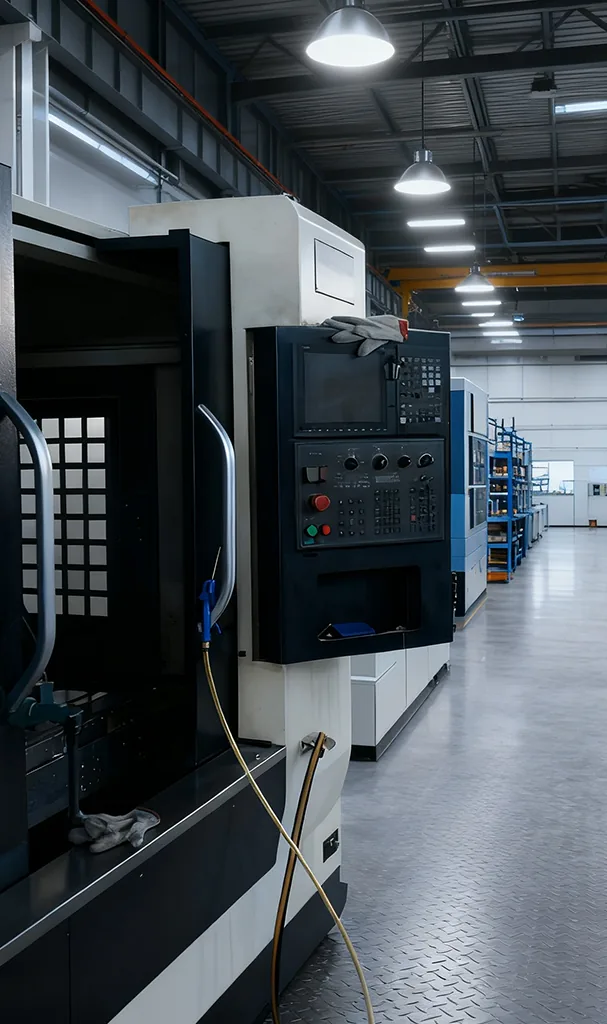
Capability claims are easy to make during sourcing. Buyers should ask for evidence that is specific to the part family, process combination, and finish requirement under review. In metal hardware and lighting accessory production, the most useful evidence is not a generic brochure. It is proof tied to similar manufacturing conditions.
- Photos or videos of relevant equipment for stamping, CNC machining, tube bending, welding, polishing, or assembly.
- Examples of similar parts with comparable thickness, geometry, finish, or cosmetic standard.
- Inspection records or sample reports showing how critical dimensions are controlled.
- Finish test data, color reference method, plating thickness standard, or coating adhesion records where applicable.
- Packaging samples for scratch-sensitive, polished, or plated parts.
- Process flow chart showing which operations are in-house and which are outsourced.
- Project communication records showing engineering clarification and change control discipline.
If the supplier cannot provide this evidence quickly, buyers should treat that as a signal. A reliable factory usually has organized records because it has handled similar work before. This does not mean every supplier needs to be the largest factory. It means the supplier should be able to prove control, not just promise it.
| Evidence Type | Why It Matters | Buyer Follow-Up Question |
|---|---|---|
| Process flow | Shows production ownership and handoff risk | Which steps are outsourced and how are they controlled? |
| Inspection report | Confirms measurement discipline | Which dimensions are checked in-process? |
| Finish sample | Reduces appearance mismatch | How is lot-to-lot finish consistency maintained? |
| Packaging sample | Protects cosmetic surfaces in transit | How do you prevent rub marks and dents? |
| Similar project case | Indicates application familiarity | What were the main production controls used? |
A practical supplier evaluation checklist before order placement
Before issuing a purchase order, buyers should confirm that technical, commercial, and operational assumptions are aligned. The checklist below is useful for internal sourcing reviews and supplier onboarding decisions.
- Drawing revision, material grade, thickness, and tolerance standard are confirmed.
- Surface finish, color expectation, cosmetic acceptance standard, and test method are documented.
- Tooling ownership, tooling lead time, and maintenance responsibility are clear.
- MOQ, price break logic, and sample-to-mass-production pricing differences are explained.
- Critical dimensions and inspection frequency are agreed.
- Packaging method for transit and storage is approved.
- Lead time is broken down by sampling, approval, production, finishing, and shipment readiness.
- Change management process is defined for drawing updates or engineering deviations.
- Communication contacts for sales, engineering, quality, and production are assigned.
- Pilot order or first article criteria are set before larger volume release.
This checklist is especially important when parts include decorative finishes or mating features that affect final assembly. If any of these points remain open, the buyer is not yet comparing suppliers on equal terms.
How to reduce sourcing risk before confirming the order
Risk reduction at the RFQ stage is usually cheaper than correction after production starts. Buyers can lower exposure by turning assumptions into documented controls.
First, standardize the RFQ package. Every supplier should receive the same drawing revision, 3D file if available, finish reference, quality expectation, annual volume estimate, packaging requirement, and target commercial terms. This improves quote comparability.
Second, request clarification in writing. If a supplier recommends a tolerance adjustment, finish alternative, or process change, ask how it affects cost, manufacturability, and appearance. Strong suppliers can explain these tradeoffs clearly.
Third, use samples correctly. A sample should not only confirm shape. It should confirm surface finish, fit, thread quality, weld appearance, and packaging protection. For visible metal hardware and lighting components, approved samples should become the reference for future lots.
Fourth, confirm whether the supplier is suitable for your order profile. Some factories are efficient for stable volume but weak on development speed. Others are flexible on prototypes but less competitive on repeat production. The right choice depends on whether your project priority is launch speed, finish quality, cost control, or supply continuity.
| Buyer Priority | Best Supplier Trait | What to Verify | Typical Risk |
|---|---|---|---|
| Fast launch | Responsive engineering and short sample cycle | Prototype capacity and revision speed | Mass-production controls may be weak |
| Stable quality | Strong process and inspection discipline | Records, gauges, finish standards | Price may not be the lowest |
| Low unit cost | Efficient tooling and batch planning | MOQ and hidden secondary costs | Service flexibility may be limited |
| Decorative finish control | Documented cosmetic standards | Approved finish sample and packaging | Lot variation and transit damage |
Finally, do not treat communication quality as a soft factor. In custom metal component sourcing, communication is part of process control. If a supplier is unclear before the order, it is unlikely to become clearer under production pressure.
Conclusion: use this RFQ guide to compare suppliers with more confidence
A strong RFQ guide helps buyers compare metal hardware suppliers on the factors that actually drive production success: capability fit, finish consistency, quality control, realistic lead times, and accountable communication. The goal is not simply to find the lowest quote. It is to identify the supplier most likely to deliver repeatable results with fewer surprises after approval.
If you are reviewing new metal hardware or lighting accessory projects, the next practical step is to compare required processes against real factory capability, then organize your RFQ package around the evidence and controls discussed above. You can review relevant service capability, prepare an RFQ for supplier feedback, or discuss OEM/ODM requirements with the team before moving to order confirmation.
If your project involves finish, tolerance, or custom production questions, the next useful step is to review lighting hardware sourcing support and rfq before finalizing drawings, samples, or mass-production requirements.
 Floor Lamp Sets
 Wall Lamp Sets
 Table Lamp Sets
 Custom Hotel Parts
 Custom Made Parts
 Panels
 Tubes
Tubes Universal joints
 Machined Parts